
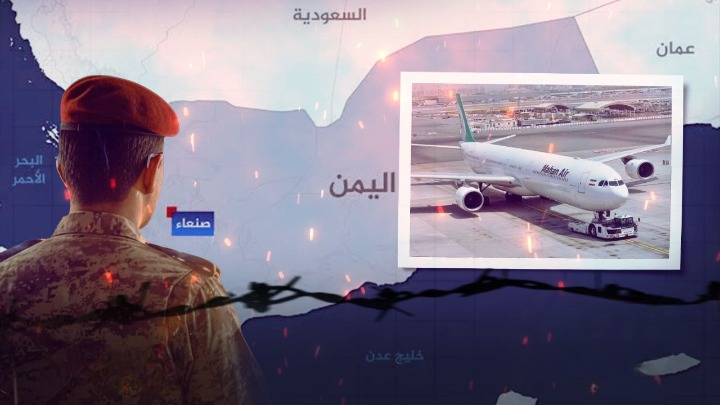
Sanaa imposes the “equation of sovereignty” by force: A strategic reading of the implications of crushing the Saudi-American air embargo and the shifts in the balance of power.
The incident that occurred in the skies over Sana’a, the capital, at 5:20 AM last Friday (July 3, 2026), transcends the dimensions of a mere aerial confrontation. It establishes a new and entirely different strategic phase in a conflict that has raged for nearly 11 years. The thwarting of the Saudi-led coalition’s attempt to intercept a civilian aircraft, and the subsequent forced withdrawal of the hostile formation, is a declaration of war, signaling a decisive shift from a phase of “managing suffering” and appealing to the international community to one of “directly seizing sovereign rights” by imposing a fait accompli through armed military force.
This pivotal shift reflects a radical change in political and military calculations. The statement issued by the armed forces goes beyond operational achievement; it establishes an ironclad defense of national sovereignty by declaring Yemeni airspace a closed zone against the aggression’s arrogance. This is a mature strategic assessment, grounded in cumulative field data, indicating that the fruitless paths of diplomatic negotiations with the Saudi-American enemy are no longer viable. The only genuine alternative to ending the humanitarian suffering and the ongoing blockade of Sana’a International Airport, which has persisted since August 2016, is to impose a mutual deterrence equation that places the enemy’s vital interests, airports, and ports under direct threat.
Overthrowing the arrogance of the enemy air and sovereignty
This direct aerial confrontation represents a qualitative leap in the development of the Yemeni Armed Forces’ air defense systems. Their operations have progressed from downing the pinnacle of advanced American technology—the neutralization of 12 MQ-9 drones during the Gaza support operation—to directly engaging Saudi fighter jets and forcing them to retreat. This development on the ground reflects Sana’a’s possession of advanced early warning and detection technologies with exceptional response times, capable of accurately distinguishing between civilian aircraft and attacking military formations operating in the same airspace.
These events effectively mean the collapse of the aerial pressure and bullying tactics the Saudi-American coalition has employed throughout the past decade. The equation has officially shifted to a “air for air” approach, where Riyadh can no longer use its air force as a tool to impose a blockade or control Yemeni airspace. The enemy’s operational inability to prevent the aircraft’s landing demonstrates a complete erosion of its maneuverability and confirms that Sana’a’s red lines are now firmly in place, stripping the joint operations rooms in Riyadh and Washington of their ability to dictate terms.
This achievement lays the groundwork for a counter-no-fly zone to protect civilian infrastructure and Yemeni sovereign facilities through deterrence. The success of the air defenses in securing the landing of the plane carrying over 200 wounded, sick, and stranded citizens ends the era of forced control over humanitarian flights. Instead of the tragic wait for regional and international inspection and monitoring mechanisms (UNVIM), Sana’a has seized full sovereignty over its airspace and airports, confirming that Yemen’s skies are no longer a playground for attacks but rather an arena for breaking the siege through direct military force.
“The Tehran Equation” and the Overthrow of Regional Hegemony
The establishment of a direct flight route between Sana’a and Tehran, and the public praise for the position of the Islamic Republic of Iran in transporting the popular and official delegations participating in the funeral of the martyr Sayyid Ali Khamenei, represents the final nail in the coffin of the “political and geographical isolation” strategy imposed on Yemen since March 2015. According to this equation, Sana’a International Airport has been transformed from a besieged gateway seeking permits for restricted and limited medical flights to Jordan through truce understandings, into a free sovereign platform directly connected to its strategic depth in the axis of resistance without any restrictions or conditions.
This declared field and political link has stripped the Saudi-American enemy of its last bargaining chip in the Muscat and Geneva negotiations. Flights are now operating according to purely Yemeni sovereign decision-making and under the protection of Yemen’s missile defense system. This new positioning forces the aggressor forces to acknowledge, against their will, the legitimate authority of Sana’a over a