
From the Mobilization Squares to the Battle for Liberation: Yemeni Tribes Renew Their Pledge to the September 21 Revolution
The tribal mobilization witnessed in the liberated provinces is no longer merely a series of solidarity events or fleeting political messages. It has become a practical expression of a new phase imposed by the September 21 Revolution, characterized by a shift from mere steadfastness to the creation of power dynamics, and from defending the homeland to full readiness to reclaim its rights and sovereignty and end the aggression and blockade.
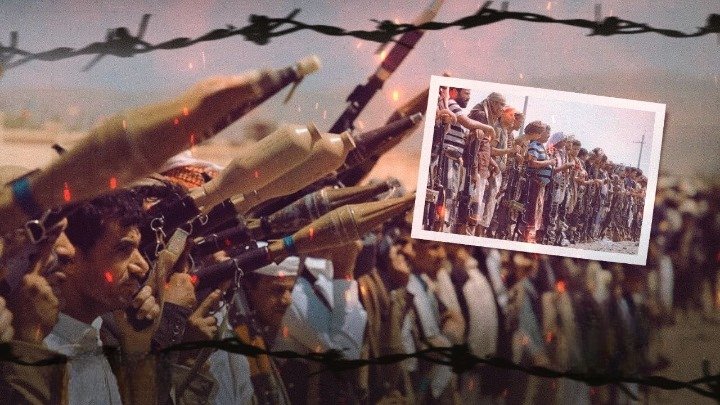
In a simultaneous display extending from Saada, Sana’a, Marib, Hajjah, and Al-Bayda, Yemeni tribes held armed gatherings and demonstrations, declaring a general mobilization and responding to the call of the revolution’s leader, Sayyid Abdul-Malik Badr al-Din al-Houthi. They affirmed that the battle for liberation is no longer a postponed option, but a national imperative imposed by years of aggression, blockade, and occupation.
A Revolution That Forged National Consciousness
Since the launch of the September 21 Revolution, a new national consciousness has emerged, restoring the independent Yemeni identity, solidifying a culture of responsibility in confronting foreign hegemony, and uniting the various components of society in the project of liberation and sovereignty. In this context, the Yemeni tribes have reclaimed their historical role as guardians of national identity, pillars of the state, and a constant source of support for the battle to defend the homeland. This is evident today in the widespread mobilization and popular and tribal readiness across various governorates.
Readiness Transforms into Action
The tribal gatherings witnessed in the districts of Al-Thawra in the capital, Sana’a, as well as in Sahar, Jahana, Bani Matar, Murad, Kuhlan Afar, Dhi Na’im, and others, were not merely public assemblies. They carried clear messages affirming complete readiness to wage the battle to end the aggression and the blockade, complete the liberation of the land, and reclaim national resources.
The participants also renewed their full mandate to the leader of the revolution, declared their support for the armed forces, and pledged to raise the level of mobilization and training, expressing their readiness to implement any options dictated by the current phase.
The Tribe: The Depth of the Deterrence Equation
These scenes confirm that the Yemeni tribe has become an integral part of the deterrence equation established by the armed forces in recent years, after Yemen proved its ability to protect its sovereignty, break the equations of hegemony, and shift the confrontation to a more balanced stage.
Today, the tribe plays not only a social role, but also represents a national and strategic asset that strengthens the cohesion of the home front, provides popular support for the liberation struggle, and embodies the unity of position between the people, the leadership, and the armed forces.
Unity of the Fronts: Steadfastness of Position
The tribal movement was not limited to Yemeni affairs. In their statements, the tribes reaffirmed their commitment to the principle of unity of fronts and their steadfast support for the Palestinian people and the axis of resistance, emphasizing that confronting the American and Zionist project is a shared responsibility, and that the battle in Yemen is part of the nation’s struggle against the forces of arrogance.
The tribes also expressed their appreciation for the positions supporting Yemen, especially the efforts that contributed to breaking the air blockade on Sana’a International Airport, affirming that the will of free peoples is stronger than all attempts at isolation and subjugation.
Towards a Decisive Phase
The widespread tribal mobilization in the liberated provinces reflects that Yemen has entered a new phase characterized by comprehensive readiness. The popular will that forged resilience throughout the years of aggression is now directed towards completing the liberation struggle, ending the blockade, and restoring full sovereignty over the land, resources, and national decision-making.
With this broad participation, the Yemeni tribes affirm that the September 21st Revolution was not a fleeting political event, but a renewed national project that rebuilt consciousness, unified ranks, and solidified a culture of pride and independence. The Yemeni tribe remains, as it has throughout history, at the forefront of defending the homeland until freedom and full sovereignty are achieved.