
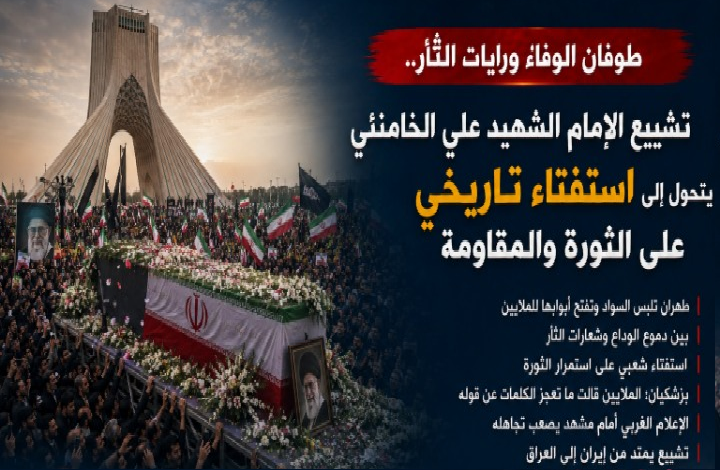
A flood of loyalty and banners of revenge… The funeral of the martyred Imam Ali Khamenei turns into a historic referendum on revolution and resistance.
Over the past few days, Tehran has been more than just a capital preparing to bid farewell to its martyred leader; it has resembled the heart of an entire nation, pulsating with both grief and resolve. From the very first moments of the funeral procession, the streets, squares, and grand plazas of the Iranian capital transformed into a surging sea of humanity, carrying with them profound feelings of loss, messages of loyalty, and a determination to continue on the path laid out by the martyred Imam, Sayyid Ali Khamenei, throughout decades of leadership, confrontation, and steadfastness.
In a scene described by observers as one of the largest popular gatherings in contemporary history, millions from various Iranian provinces, along with delegations, figures, and crowds from multiple parts of the world, flocked to participate in the funeral ceremonies of the martyred Imam, in an event that transcended its national dimensions to become an exceptional political, popular, and strategic milestone, carrying clear messages to allies and adversaries alike.
Tehran dons black and opens its doors to millions
With the first hours of dawn, the roads leading to the funeral squares, metro stations and main streets were crowded with groups of mourners who came from various Iranian cities and towns, while the capital seemed to be moving in one direction towards the great farewell procession.
The squares were filled to their maximum capacity, which prompted the organizers to modify the routes of some funeral events as a result of the unprecedented influx of crowds, in a scene that reflected the scale of popular participation that exceeded all expectations.
The crowds carried pictures of the martyred Imam, Iranian flags and religious banners, while chants affirming adherence to the option of revolution, independence and sovereignty rose, turning the funeral ceremony into a comprehensive scene in which religious symbolism was mixed with the national and political dimension.
Between tears of farewell and slogans of revenge
A striking scene unfolded during the funeral procession, combining profound grief with escalating anger. While roses, jasmine, and rosewater covered the coffin of the martyred Imam in a widespread expression of gratitude and loyalty, chants of vengeance and retribution against those whom the masses held responsible for the assassination rang out.
In various funeral processions, chants against the United States and the Zionist entity were heard, while banners and slogans were raised affirming that the blood of the martyred Imam would not be shed in vain, and that the resistance movement would continue with greater momentum.
This interplay between emotional loyalty and political determination gave the funeral ceremonies an exceptional character, transforming them from a funeral occasion into a unifying national event that embodies the state of popular mobilization and broad support for the principles that the martyr defended throughout his life.
A popular referendum on the continuation of the revolution
Observers believe that the millions of people who filled the Iranian capital were not merely an expression of grief over the loss of a prominent leader, but rather represented a broad popular referendum on the continuation of the Islamic Revolution project and its strategic choices.
The large turnout, which included various age groups and social classes, men, women, youth and children, carried a clear message that the martyrdom of leaders does not weaken peoples or dismantle their projects, but rather pushes them towards greater cohesion and rallying around the principles they believed in.
Many observers also considered that the broad popular participation reflected the strength of the Iranian home front after years of pressure, sanctions, threats and wars, and showed that the relationship between the people and their leadership goes beyond narrow political calculations to the level of belonging to the national and civilizational project represented by the Islamic Republic.
Pezeshkian: Millions have said what words cannot express.
Amid the unprecedented public scene, Iranian President Masoud Pezeshkian affirmed that the millions who participated in the funeral procession sent a message that the whole world understands without the need for translation or interpretation.
He explained that actions and practical stances are more expressive than words and speeches, noting that the tears that appeared in the eyes of men, women and children during the funeral ceremonies were not an artificial scene, but rather a sincere expression of the extent of lo