
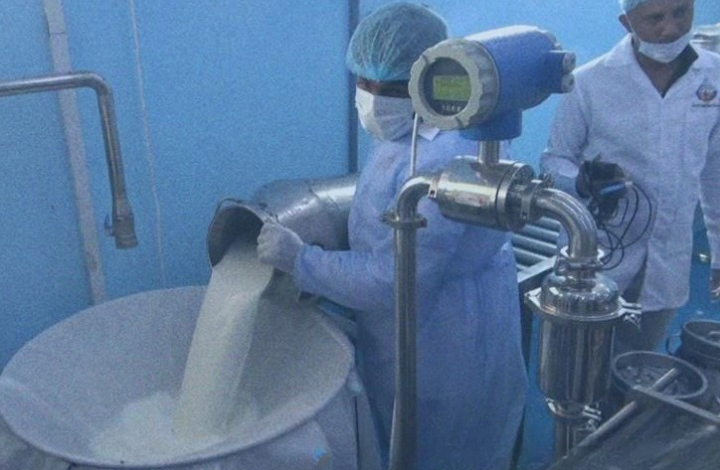
Localizing the Dairy Industry: The 21 September Revolution Launches the Battle for Self-Sufficiency and Breaks Food Dependency
Yemen’s struggle with imports was never a battle of numbers or commodities; it was a battle of sovereignty and decision-making. For decades, the country was turned into an open market flooded with foreign products, while local production was marginalized, rural areas were drained, and agricultural and livestock value chains were dismantled—until Yemen, despite its resources, came to depend on external sources for its daily food.
Today, following the 21 September Revolution—which liberated sovereign decision-making from U.S. and Gulf tutelage—the country is witnessing a qualitative shift in its economic approach. One of the clearest manifestations of this shift is the strategy to localize the dairy industry, presented as a practical model for moving from importation to production, and from dependency to self-sufficiency.
How Food Dependency Was Engineered
Import data reveal that Yemen spent hundreds of millions of dollars annually on importing milk and dairy products, despite possessing vast local production potential. In 2023 alone, imports of milk, cheese, butter, and ghee exceeded USD 384 million—quantities equivalent to an annual demand of nearly 948,000 tons of raw milk, or more than 2.6 million liters per day.
This reality did not emerge by chance, but resulted from:
Deliberate dumping policies
Lack of protection for local products
Marginalization of rural areas and farms
Dismantling of agricultural value chains
Tying food security to external markets
More dangerously, this model turned food into a tool of political and economic pressure and a means of blackmail against nations—an outright violation of their right to sovereignty.
Localizing the Dairy Industry: The Numbers Speak
From the launch of the National Strategy for Localizing Dairy Production (NSLD) in June 2023 through December 2025, unprecedented results have been achieved—particularly in Hodeidah and Tihama:
Production capacity increased from 16,470 liters/day to 157,000 liters/day, a growth of over 850% in two and a half years.
The number of productive cows rose from 4,186 to 40,000.
More than 81.4 million liters of milk were produced, valued at over 34.5 billion Yemeni rials.
Annual import savings reached USD 19 million (over 10 billion rials).
Over 20,884 direct jobs were created in Hodeidah alone across the value chain, benefiting more than 104,000 people directly and indirectly.
Cash liquidity injected into local markets exceeded 34.5 billion rials, stimulating local economic activity.
These outcomes were not the result of raw production alone, but of an integrated system that included:
Establishing milk collection centers
Financing cattle purchases
Equipping veterinary clinics
Supporting feed supply and refrigerated transport
Direct government support of 80 rials per liter
The strategy also carried a strong social dimension by empowering cooperatives, supporting persons with disabilities, families of martyrs, and those affected by war, and broadening the base of beneficiaries—making localization a comprehensive development project rather than a narrow sectoral one.
The First Joint Decision: Protecting Production Through Sovereignty
A landmark shift came with the first joint decision by the Ministries of Finance, Economy, Industry, and Investment, which:
Banned imports of goods fully covered by local production, foremost liquid milk
Restricted imports of goods partially covered by local production
Redirected import expenditures inward
The Acting Prime Minister, Mohammed Muftah, affirmed that these measures aim to regulate imports and support national production, while the Minister of Finance, Abduljabbar Ahmed, stressed that they constitute effective protection programs—not emergency measures.
Production as a Duty; Sovereignty as a Responsibility
Localizing dairy production falls within a clear Qur’anic vision: “Eat of the provision of Allah and be grateful to Him.”
A vision that does not separate gratitude from work, nor worship from production.
Guidance from Sayyid Abdul-Malik Badr al-Din al-Houthi laid the intellectual foundation for this path, repeatedly emphasizing that:
Protecting national products is a sovereign duty
Regulating imports is a necessity, not a choice
Consumer awareness is the first line of defense
Pooling capital through cooperatives is the path to revival
No nation retains dignity if it imports everything despite the ability to produce
This vision has now translated into practical policies that restore the primacy of production and place the economy in service of society—not the other way around.
The 21 September Revolution: The Root That Returned Yemen to Itself
These transformations would not have been possible without the 21 September Revolution, which:
Liberated economic decision