
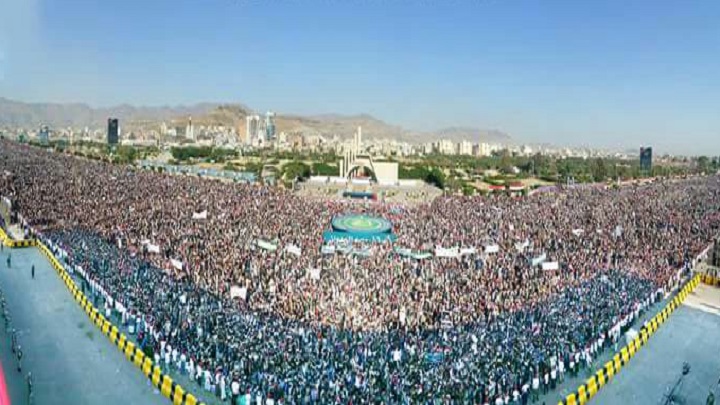
Yemeni Unity Between Slogan and Practice: How the September 21 Revolution Exposed the False Unifying Rhetoric and the Project to Fragment Yemen
Yemeni unity represents one of the most fundamental national constants of the blessed September 21 Revolution. It is not merely a slogan or a set of geographic borders; rather, it is a safety valve for the state’s independence and its ability to make sovereign national decisions free from any external tutelage. This vision was not formulated as abstract rhetoric, but as an integrated strategic framework linking territorial unity with the safeguarding of sovereign decision-making and the management of national resources in a manner that prioritizes, first, the interests of the Yemeni people, and second, the capacity to confront any foreign interference. From this standpoint, Sana’a regarded unity from the outset not as an abstract value, but as a practical benchmark by which the strength of the state and the credibility of political forces in protecting land and people are measured. Any unifying discourse that fails to translate into actual sovereignty remains an empty façade, easily exploited to serve projects of fragmentation and domination.
With the launch of the unjust aggression against Yemen, led by Saudi Arabia and the UAE with American support and Zionist supervision, unity shifted from a theoretical test to a revealing criterion of real positions. The reality became fully exposed: forces and parties that had long proclaimed their defense of unity and sovereignty chose, in practice, to align with foreign powers, transforming into tools and mercenaries serving a project of division and the dissolution of national unity between north and south. This deviation was not a fleeting tactic, but an ongoing alliance-based strategy, demonstrating that nationalist rhetoric had merely been a cover, while true loyalty shifted from land and people to foreign actors. Thus, unity became a concrete and realistic measure of credibility, and the September 21 Revolution emerged not only as a political movement, but as a revealing force distinguishing between those who stand with sovereignty and those who become part of the aggression’s project to dismantle the Yemeni state.
Advocates of Unity and the Handover of the South to UAE Militias
With the start of the Saudi–UAE–American aggression against Yemen in March 2015, the true loyalties of political forces that had long claimed to defend national unity were laid bare. UAE-backed Southern Transitional Council militias seized control of military camps, ports, and vital facilities in Aden, Lahij, and Abyan, extending their reach to the presidential palace, while central state institutions were absent from any effective role. This reality enabled the UAE to impose its influence over resources and manage key institutions as part of a project aimed at dismantling the national state.
Political and media complicity emerged among certain leaders of the Islah Party, who provided political cover for the separatist takeover and obscured the expansion of militia influence, portraying it as an “irreversible reality.” The public media positions of these figures highlighted the contradiction between unifying rhetoric and on-the-ground reality, confirming that their actual loyalty was tied to external interests rather than the protection of land and people.
The national resistance in Sana’a—represented by the army, armed forces, and political components—confronted the militias and restored state institutions, affirming that national unity is not merely a media slogan, but a practical exercise requiring national will and effective protection of sovereignty against separatist projects.
The social and economic impact of separatist control was immediate. The paralysis of institutions led to the suspension of basic services and the worsening of living conditions in the south, revealing that compromising sovereignty harms not only the state, but also the daily lives of citizens, turning the south into an operational arena for foreign agendas when it should have been a center of stability and services.
The Saudi and Emirati Role in Dismantling Yemen and the Silence of Mercenaries
Emirati actions in the south went beyond logistical support to include the construction of local militias outside any institutional framework of the state, most notably the Southern Transitional Council, which formally announced itself in May 2017 after years of control over camps, ports, and vital facilities. This separatist project followed the systematic dismantling of state institutions in Aden and the removal of security and military decision-making from any unified Yemeni authority, enabling the UAE to entrench its influence and turn the south into an executive arena for its interests.
In August 2019, these militias seized the presidential palace and government headquarters, forcibly expelling the so-call