
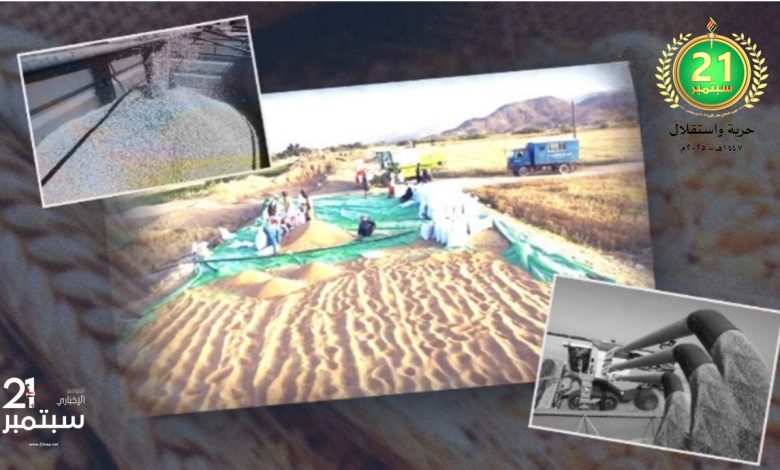
When the Land Became a Weapon: Agriculture and the Battle for Self-Sufficiency after the September 21 Revolution
Yemen’s confrontation with the forces of aggression and arrogance was not merely a military battle; at its deepest core, it was a struggle over sustenance—over who controls food decisions and who holds power over the daily loaf of bread. For decades, Yemen’s land was systematically stripped of its productive role, transforming society from a people who cultivated and sustained themselves into consumers dependent on global grain warehouses. This was part of a deliberate policy aimed at subjugating national decision-making through the weaponization of food.
The September 21 Revolution came to overturn this equation entirely—liberating political decision-making and laying the foundation for a comprehensive liberation path, at whose heart lay the emancipation of agriculture from dependency and the transformation of self-sufficiency from a moral slogan into an integrated national and sovereign project.
How Food Dependency Was Engineered
Prior to the blessed September 21 Revolution, Yemen’s agricultural sector suffered from deep structural distortions. These were not the result of scarce resources or human incapacity, but of deliberate policies designed to:
Dismantle rural productive structures and marginalize small farmers.
Flood markets with imports—particularly wheat and maize—turning local agriculture into a losing endeavor.
Undermine seed sovereignty through reliance on foreign corporations and imported seeds.
Replace production with aid, using international organizations as a soft tool to disable self-reliance.
The figures reveal the scale of the catastrophe: a food gap approaching 94% in wheat and over 86% in maize, with an import bill exceeding one billion dollars annually—despite Yemen possessing millions of arable hectares and millions of capable hands.
This reality was not merely an economic imbalance, but a direct threat to national security, turning food into a tool of political blackmail in the hands of Washington and its allies—parallel to aircraft and missiles in their war on Yemen.
An Agricultural Revolution from the Heart of the Siege
1. Liberating Agricultural Philosophy: From the Individual to the Collective
One of the most significant transformations ushered in by the September 21 Revolution was the shift from isolated individual farming to a model based on production clusters and value chains, through:
Organizing small farmers (over one million holdings) into specialized groups.
Reducing production costs and increasing yields through vertical expansion.
Linking fields to processing and marketing within an integrated national cycle.
This model was not merely technical, but social and cultural—rebuilding trust and solidarity in rural Yemen and reducing conflicts over land and water.
2. Wheat and Maize: Breaking the Most Dangerous Link
Between 2020 and 2025, the grain sector witnessed qualitative transformations:
Al-Jawf Governorate became a major grain basket, with significant increases in cultivated areas and production, and a reduction in the cost of local wheat to levels competitive with imports.
Al-Hudaydah and Tihama reclaimed their historic roles, shattering decades-old myths about the impracticality of wheat cultivation in coastal regions.
Maize was freed from dependence on imported feed, through contract farming and direct linkage between farmers and feed and poultry factories.
3. Sovereignty over Seeds and Technology
At the core of the battle, it became clear that self-sufficiency cannot be achieved without control over seeds and tools. This prompted a drive toward:
Producing thousands of tons of improved local wheat seeds.
Breaking the monopoly of foreign corporations over genetically modified seeds.
Localizing the manufacture of agricultural equipment (threshers, solar dryers, honey processing lines, peeling machines), reducing costs and increasing added value.
4. Institutions and Society in One Trench
Key roles emerged for:
Agricultural cooperative associations as a powerful field arm.
Bonyan Development Foundation in engineering community participation and creating “development champions.”
Mosques, schools, and councils as centers of awareness and mobilization—transforming agriculture from an occupation into a sovereignty cause.
Self-Sufficiency as a Faith-Based and Sovereign Duty
The vision governing this transformation stems from a clear Qur’anic foundation, repeatedly emphasized by Sayyed Abdul-Malik Badr Al-Din Al-Houthi—may God protect him—namely that:
Self-reliance is part of the perfection of faith.
Leaving land barren when capable of cultivating it is a squandering of God’s blessing.
Liberation from economic dependency is a prerequisite for political liberation.
The Qur’an links faith with action, gratitude with preservation, and regards striving to cultivate the land