
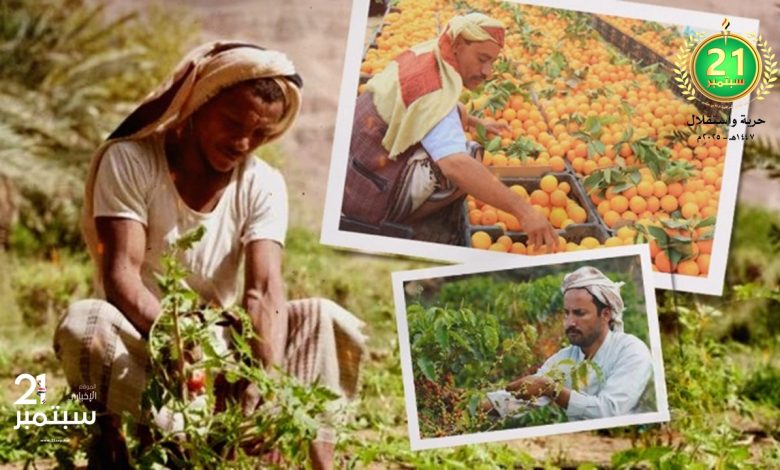
From Breaking the Siege to Reclaiming Sovereignty: Agriculture After the September 21 Revolution Dismantles the Weapon of Starvation
The glorious September 21 Revolution was not a fleeting political event, nor merely a shift in power balances. It marked a historic turning point that redefined the Yemeni relationship with land, the state’s stewardship of its resources, and national decision-making as an expression of sovereignty.
In a country subjected for years to warfare through starvation and systematic impoverishment, agriculture—after the revolution—was transformed from a marginalized sector into a front line of sovereign resistance; from a limited subsistence activity into a comprehensive national project. It shattered the bets of U.S. and Saudi aggression, wrested food decision-making from foreign control, and returned the land to its people.
How Dependency Was Engineered: When Food Became a Tool of Subjugation
Before the September 21 Revolution, the deterioration of agriculture in Yemen was not the result of incapacity or lack of resources, but of deliberate policies aimed at undermining self-sufficiency and tethering national decision-making to global ports:
Dismantling rural productive structures and neglecting small farmers.
Flooding markets with imported wheat and corn, turning local farming into a losing endeavor.
Undermining seed sovereignty and tying it to foreign corporations.
Replacing production with relief, and using international organizations as instruments of “soft” disruption.
The result was a catastrophic food gap—exceeding 94% in wheat and 86% in corn—and an annual import bill surpassing one billion dollars, in a country endowed with land, water, and people. Food thus became a political weapon in the hands of Washington and its allies, parallel to aircraft and missiles.
The September 21 Revolution: When Land Became a Weapon
With the liberation of political decision-making after the glorious September 21 Revolution, a parallel battle no less fierce was launched: the battle for self-sufficiency.
This was not merely a technical or economic choice, but a sovereign and faith-based one—articulated by Sayyed Abdul-Malik Badr al-Din al-Houthi in multiple speeches—linking self-reliance to the completeness of faith, and land stewardship to political liberation.
Key transformations included a shift from isolated individual farming to:
Organizing more than one million agricultural holdings into production groups.
Building value chains connecting fields to marketing and processing.
Reducing costs and increasing productivity through vertical expansion, not only horizontal growth.
This transformation rebuilt rural trust, reduced disputes, and turned agriculture into an organized collective endeavor.
Al-Jawf and Tihama: Breaking the Most Dangerous Link
At the heart of food sovereignty, grains took center stage:
Al-Jawf became a national breadbasket, with local sack costs falling to levels competitive with imports.
Tihama and Al-Hudaydah dismantled the myth that coastal wheat cultivation is unviable.
Yellow corn broke free from dependence on imported feed through contract farming and linking farmers to factories.
Taiz and Raymah: Development from Within the Community
Taiz: Sustainable Agricultural and Cooperative Revival
Despite targeting and siege, Taiz Governorate is witnessing notable agricultural momentum:
Establishment of 11 multi-land cooperative associations.
Marketing of strategic crops such as peanuts; the Al-Salwah Cooperative launched a new shipment of 4 tons.
Solar energy and modern irrigation projects expanded cultivated land in Khadeer to 21 hectares.
Empowering affected families through livestock distribution, transforming relief into productive assets.
Abdullah Al-Jundi, Director of the Governorate’s Agriculture Office, confirms these projects increased output, reduced costs, and strengthened food security under siege.
Raymah: Al-Dhulou’ Dam—When Community Action Speaks
In Raymah, developmental awareness is embodied in the Al-Dhulou’ Dam:
Irrigation of more than 32 hectares.
Storage capacity approaching 33,000 cubic meters.
Total cost around 160 million rials, largely financed through community efforts.
Community committee head Munjed Al-Eidroos affirms the project is a strategic economic asset and a manifestation of the cooperative spirit forged by the revolution.
Hajjah: Aslam Rice—A Sovereign Crop Returns from Exile
In Hajjah Governorate, specifically Aslam District, rice cultivation has returned after decades of exclusion:
Cultivation of more than 25 hectares.
Production leap from 17 tons to 30–50 tons.
Marketing a 50-kg sack at prices reaching 25,000 rials.
It is the return of a sovereign crop—breaking Yemen’s dependence on external markets and turning every water spring into a front of economic resistance.
Strategic Marketing: When the Battle Moved from Field to Market
Engineer M