
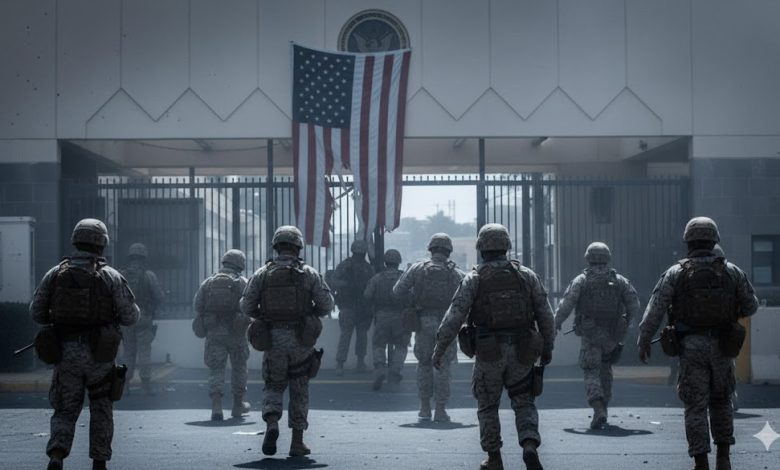
Barefoot and Unarmed Marines: Behind the Scenes of February 11 and the Humiliating Escape from Sana’a: How America’s Stronghold Fell
February 11, 2015, officially ended the era of the United States’ “diplomatic-military presence” in Sana’a, with the closure of the embassy and the evacuation of its staff after four years of managing the situation through the “Restructuring Committee” and the Office of Military Cooperation (OMC). This date represents a moment of “operational disengagement,” as Washington lost control over the three sovereign spheres (political decision-making, intelligence structure, and military leadership). Yemen transitioned from a status of “annexed state” under the Gulf Initiative to one of “full sovereignty” imposed by the effects of the September 21 Revolution, leading to a strategic “monitoring gap” for the Pentagon that persisted for a full decade.
Military data confirms that the evacuation of the “ground operations base” in Sana’a in 2015 was the key factor that allowed for the launch of the “arms self-sufficiency” program, operating outside the direct oversight of the Central Intelligence Agency (CIA). This transformation enabled the armed forces to build a missile and hypersonic arsenal, moving from a phase of “central defense” to one of “cross-border deterrence” and “enforcing a maritime blockade” in 2024-2026. According to this characterization, February 11th marks the effective “fall of the tutelage” and the beginning of a phase of direct confrontation that removed Yemen from the orbit of “unipolarity.”
Dismantling the “deep structure” of the occupation
Overthrowing the tutelage
The September 21st Revolution halted the “systematic destruction” of defense capabilities led by Washington between 2012 and 2014, which resulted in the detonation and destruction of approximately 1,500 missiles from air defense systems (Strela and SAM-7) under the direct supervision of American experts. The expulsion of the Marines on February 11, 2015, was the executive measure taken to protect the remaining strategic stockpiles and to sever the “espionage networks” that operated 48 coordination offices within sovereign state institutions. This revolutionary achievement transformed Yemen from absolute subservience to the US State Department to complete constitutional independence.
Statistics from security agencies in Sana’a show that the rate of security breaches and political assassinations decreased by 92% after the departure of the US mission, which had provided cover for intelligence units that orchestrated chaos under the guise of counterterrorism. According to the political discourse of the revolutionary leadership, the 2015 withdrawal provided the necessary national environment for building a combat doctrine for the Yemeni army that transcended the restrictions imposed for years by the US military attaché. This transformation enabled Sana’a to restructure the military establishment on purely national foundations, free from the US veto that had prevented the acquisition of weapons with a range exceeding 300 kilometers.
The events of February 11th proved the failure of the international containment project. The evacuation of the Marines transformed from a diplomatic withdrawal into a strategic collapse of the Gulf Initiative and its instruments. The strategic report documents that the mission’s departure led to the cessation of conditional funding that had been used as a tool of political blackmail to impose decisions serving the interests of the Zionist entity. This financial and political independence enabled Sana’a to declare its direct participation in the “Promised Conquest and Holy Jihad,” a stance that would not have been possible while a US operations base was present within the capital.
Statistics on the “Withdrawal” at Sana’a Airport
Records at Sana’a Airport dated February 11, 2015, show that Marines destroyed 250 individual and medium-caliber weapons (M4 and M24 models) using hand tools within the airport premises, after negotiations to remove them from the country failed. This technical procedure reflects the loss of US “field control,” forcing the troops to depart in “civilian clothing” on commercial Oman Air flights. Intelligence sources classified this as the largest “military disarmament” operation a Marine unit in the Middle East had undergone in decades.
In addition to the weapons, the US mission left behind material and military assets, including 32 armored vehicles (Level 7 armor) and enormous quantities of encrypted communication devices, which were seized and technically dismantled. This logistical collapse resulted in an “information blindness” within the National Security Agency (NSA) that persists to this day. The Pentagon currently acknowledges its inability to estimate the size of Yemen’s underground missile depots, a consequence of the loss of field intelligence sources previously provided by the embassy and its intelligence apparatus before 2015.
The Geography of Retreat and Maritime Escape
Military analysts link the evacuation of Sana’a (2015) to the forced withdrawal of US fleets from the Red Sea (2024-2026). Washington lost the “ground cover” that had secured the movements of its warships. Official figures indicate that the cost of US air defense to intercept Yemeni drones reached $1.2 billion in just six months—a financial drain resulting from the loss of the ability to launch a “preemptive strike” from within Yemen. Yemen’s transformation into a “base of deterrence” is a direct result of the decision to expel the Marines, which ended the era of “operations from within” and transformed it into a “state-to-state” confrontation.
The 2015 scenario is repeating itself at sea with the withdrawal of the aircraft carriers (Eisenhower and Lincoln) after they were subjected to direct ballistic missile threats. The Yemeni armed forces have demonstrated the collapse of the American “doctrine of maritime supremacy.” Technical reports confirm that the “forced withdrawal” of the carriers represents a failure to achieve the objective of “protecting Zionist navigation,” an extension of the failure to protect the “embassy compound” in Sa’wan a decade ago. This sequence confirms that Yemen has imposed a “forbidden geography” equation that begins on land and extends to the Indian Ocean.
The expulsion of America represents a victory for the “narrative of power” over the “narrative of dependency.” Yemen is now the only regional state free of any American bases or security “liaison offices.” This sovereign vacuum has been filled by local manufacturing capabilities that have made Yemen an influential player in controlling the Bab al-Mandab Strait (through which the Mediterranean Sea passes).