
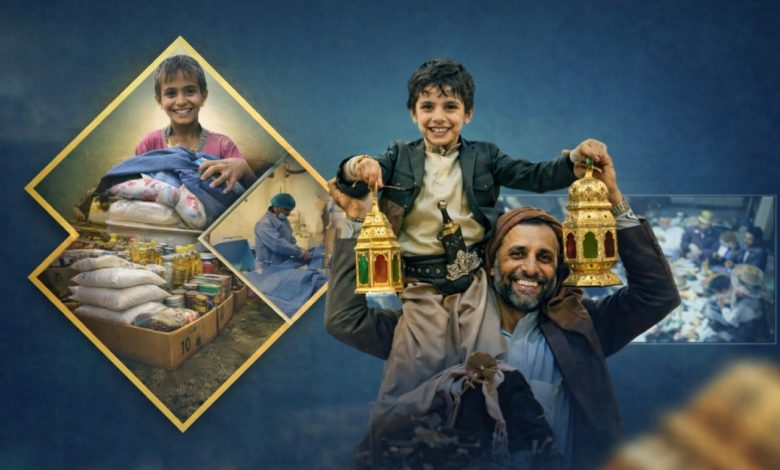
The Epic of Ramadan Solidarity in Yemen: A Testament to Resilience that Defeated the Starvation and Blockade
With the arrival of the holy month of Ramadan, the capital Sana’a and the liberated governorates are witnessing a widespread humanitarian movement embodying the highest forms of social solidarity and compassion that characterize the Yemeni people. This scene reflects the deep-rooted faith within the society, despite the economic challenges and exceptional circumstances resulting from the ongoing aggression and blockade.
This community movement comes as a direct response to the directives of the Leader of the Revolution, Sayyid Abdul-Malik Badr al-Din al-Houthi, who emphasized in his Ramadan lectures the importance of seizing the opportunity of this blessed month to strengthen the values of charity and solidarity, and to continuously check on the conditions of the poor, the needy, the families of martyrs, and those stationed on the front lines, thereby bolstering the resilience of society and the cohesion of its internal front.
Leadership Directives: Compassion is a Religious Responsibility
The directives of the revolutionary leadership served as a practical starting point for official institutions and community initiatives to expand humanitarian work. The General Authority for Zakat and charitable organizations translated these directives into extensive field projects targeting the most vulnerable groups in various governorates.
These efforts affirmed that the month of Ramadan represents a spiritual milestone for strengthening the values of cooperation and social solidarity, and for solidifying the spirit of collective responsibility in the face of difficult economic circumstances.
Zakat Projects 1447 AH: Figures Reflecting the Extent of Giving
In a practical demonstration of the scale of community solidarity, the General Authority for Zakat launched its Ramadan charity projects for the year 1447 AH at a total cost of 26 billion riyals, targeting more than 580,000 families and beneficiaries in various governorates.
The projects were distributed across several humanitarian and service tracks, most notably:
– Cash assistance to approximately 250,000 impoverished families at a cost of 5 billion riyals.
– Distribution of Zakat al-Fitr to 180,000 families at a cost of 3.582 billion riyals.
– Monthly support for families unable to work, covering 43,000 families at a cost of 2.579 billion riyals.
– Medical assistance benefiting approximately 4,000 individuals at a cost of 1 billion riyals.
– Eid clothing for approximately 75,000 beneficiaries in the capital city at a cost of 475 million riyals.
– Support for bakeries and charitable kitchens serving approximately 2,000 families at a cost of 100 million riyals, in addition to community initiatives in several governorates.
The projects also included support for the health sector, universities, and scientific centers, as well as contributions to social services, within an institutional Zakat framework aimed at expanding the social safety net and strengthening community solidarity.
Field Initiatives: Models of Solidarity Reaching Neighborhoods
On the ground, community initiatives continue across various governorates. The opening of a Ramadan charity kitchen in Dhamar Governorate, providing approximately 2,500 meals daily to the poorest families throughout the month of Ramadan, serves as a prime example of these solidarity efforts. In the capital, Sana’a, 1,500 food baskets were distributed to needy families in the Al-Hatarish neighborhood of Bani Al-Harith District for the seventh consecutive year, demonstrating the continuity of grassroots initiatives and the growing spirit of cooperation among community members.
Furthermore, the distribution of food baskets and cash assistance to the families of martyrs and missing persons in Hajjah Governorate, at a cost exceeding 165 million riyals, represents another example of ongoing programs that support these groups and underscores the continuity of humanitarian work during Ramadan.
Ramadan Solidarity: A Safety Valve and a Countermeasure to the Blockade
Despite the ongoing blockade and economic pressures, social solidarity has emerged during Ramadan as a crucial factor in national resilience. Humanitarian initiatives have transformed into a vital internal support front, mitigating the effects of the economic war and safeguarding the livelihoods of citizens. The Yemeni experience has demonstrated that a cohesive society, bound by the values of benevolence and compassion, is capable of thwarting attempts to starve and break the will of the people. It can transform challenges into opportunities for giving and mutual support, thereby strengthening social stability, fostering a culture of self-reliance and collective responsibility, and bolstering confidence in institutional and volunteer work.
A renewed message of resilience
This cohesion between the leadership and society, and between official institutions and popular initiatives, sends a clear message that the enemies’ bets on breaking the will of the Yemeni people through siege and starvation have fallen before the rock of solidarity and compassion. The epic of Ramadan solidarity confirms year after year that Yemeni society, by adhering to its faith values and social cohesion, is able to continue to stand firm and turn challenges into strength and giving that reinforces steadfastness until the achievement of complete victory.