
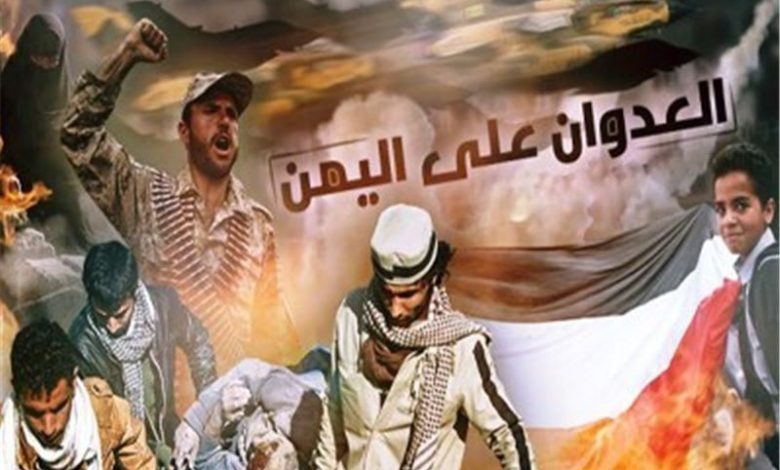
March 26th: A Day of Aggression and Renewed Crimes: A Documented Record of the US-Saudi-Emirati Aggression Against Yemen
March 26th marks a turning point in Yemeni memory, not only as the beginning of the US-Saudi-Emirati aggression, but also as a day on which the pattern of brutal targeting of civilians and infrastructure has been repeated throughout the years of aggression.
From the first strike that hit residential neighborhoods in the capital, Sana’a, the crimes continued on this specific day, revealing a systematic policy based on mass killing and the destruction of the Yemeni people’s resources, in flagrant violation of all international and humanitarian laws.
2015: The Bani Hawat Massacre: The Aggression Begins with Civilian Blood
On March 26, 2015, the aggression launched its first major crime by targeting a residential neighborhood in the Bani Hawat area of the capital, Sana’a, resulting in the martyrdom of 29 citizens and the injury of 43 others, the majority of whom were women and children. This massacre revealed from the very first moment the true nature of the aggression’s objectives.
In the same context, the aggression’s warplanes launched a series of raids on Sana’a International Airport, Al-Dailami Air Base, and various areas in the capital and Sana’a Governorate, targeting both civilian and military installations in an attempt to cripple the country’s infrastructure.
2016: Cluster Bombs and Expanded Targeting
On March 26, 2016, the aggression continued its crimes by targeting the Al Awadh Dam in the Radman District of Al Bayda Governorate, resulting in the deaths of two civilians and injuries to a third. A civilian’s home in the Al Matun District of Al Jawf Governorate was also targeted, leading to his death.
The raids extended to the Nihm, Arhab, and Sanhan districts of Sana’a Governorate, causing widespread damage to civilian homes. In a dangerous escalation, the aggression’s warplanes used internationally banned cluster bombs to target areas in the Sirwah District of Ma’rib, in addition to heavy shelling north of the district’s market.
2017: Targeting Bedouin and Populated Areas, Escalation of Border Attacks
On March 26, 2017, the Saudi-led coalition warplanes targeted Bedouin tents in Najd al-Aswad, Nihm District, injuring several people. This attack reflects the coalition’s continued targeting of the most vulnerable groups.
The coalition also launched airstrikes on Bilad al-Rus and Bani al-Harith districts in the capital, Sana’a, and the al-Ahyuq Triangle in Taiz. On the border, the Saudi army opened fire on populated areas in Munabbih District, Sa’dah Governorate, coinciding with airstrikes on Kataf and Majz, and the shelling extended to al-Rabu’ah in Asir.
2018: Intense Bombing of Sa’dah and Hodeidah, and Expansion of the Aggression
On March 26, 2018, the coalition escalated its airstrikes, targeting Sa’dah city and its districts with 12 raids. This coincided with Saudi missile shelling of border areas in Munabbih.
The airstrikes extended to Hodeidah Governorate, targeting the districts of Zabid and Beit al-Faqih, and to Hajjah Governorate with nine airstrikes on Haradh and Midi. Al-Mahwit, Taiz, Lahj, and Sana’a were also targeted, reflecting the widening scope and comprehensiveness of the aggression.
2019: Targeting Health Facilities: A Crime Against Humanity
On March 26, 2019, the aggression’s warplanes committed a horrific crime by targeting the gate of the rural hospital in Kataf District, Sa’dah Governorate. This resulted in the death and injury of more than 15 civilians, including children, in a flagrant violation of international humanitarian law, which prohibits targeting medical facilities.
2020: Intensified Airstrikes on Sa’dah and Hajjah and Targeting of Economic Facilities
On March 26, 2020, the aggression’s warplanes launched airstrikes on Razih and Shada’a districts in Sa’dah Governorate, causing damage to civilian property. They also targeted the city and customs office of Haradh in Hajjah Governorate with nine airstrikes, attempting to cripple the economic and commercial lifeline. The airstrikes extended to the Bakil al-Mir district, as part of a continued escalation in border areas.
2021: Continued Air Escalation on Marib
On March 26, 2021, the aggression’s warplanes launched 12 airstrikes on the Madghal and Sirwah districts in Marib Governorate, as part of its ground efforts to support its mercenaries with intensive air cover.
2022: Massacres in the Heart of the Capital and Systematic Targeting of Service Facilities
On March 26, 2022, the aggression committed one of its most heinous crimes by targeting two houses in the Haddah area of the al-Sabeen district in the capital, Sana’a, resulting in the martyrdom of ten civilians, including women and children.
It also launched a series of airstrikes on the al-Hafa and al-Nahdain areas and the Safer Company compound, in addition to targeting areas in Sanhan in Sana’a Governorate. In Hodeidah, a health center on Kamaran Island, a medical warehouse belonging to Al-Aqsa Hospital, oil facilities, the port of Salif, and a gas station were targeted, in a clear indication of the deliberate destruction of the health and service sectors.
The airstrikes extended to Hajjah, Al-Jawf, and Marib, as part of a comprehensive escalation across various fronts.
2023: Field Violations and Continued Attacks in Hodeidah
On March 26, 2023, the aggression’s mercenaries continued their violations by establishing combat fortifications in the Hays district of Hodeidah Governorate and shelling various areas with artillery and machine guns, in a persistent violation of the ceasefire agreements.
The Memory of the Crime and the Beginning of the Aggression in One Day
Reviewing the crimes of March 26 reveals a stark paradox: it is the day the aggression began and the day the crimes continued at a recurring annual pace, confirming that what Yemen is experiencing is not merely a war, but a systematic project of destruction targeting its people, land, and identity.
This history will remain a living witness to crimes that do not expire with time, and to the steadfastness of a people who faced aggression with an unyielding will, turning pain into strength, and memory into a weapon in the battle of awareness and liberation.