
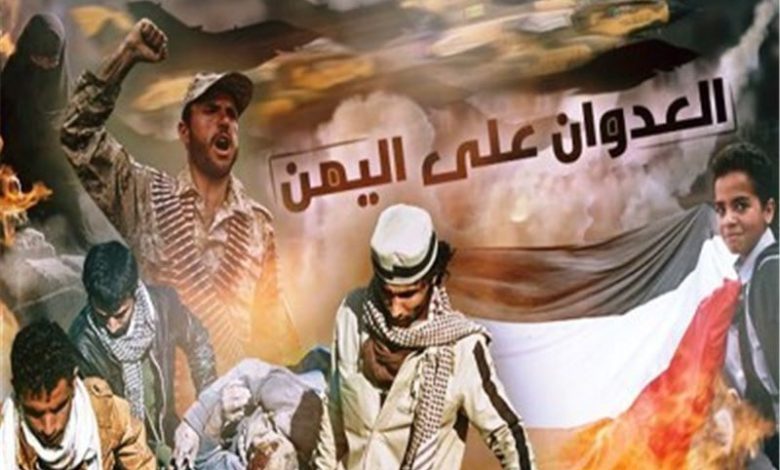
Crimes That Will Not Be Forgotten: April 11 – A Day That Exposes the Brutality of the US-Saudi-Emirati Aggression in Yemen
In a recurring cycle of bloodshed, April 11 stands out as a day that encapsulates the full extent of the US-Saudi-Emirati aggression in Yemen. On this day, airstrikes and artillery shelling intersect, and the scope of targeting expands to encompass both people and the very foundations of their lives.
From residential neighborhoods to universities and factories, from stadiums to communication networks, a clear pattern of systematic targeting emerges, one that transcends the military dimension to strike at the social and economic fabric of the country.
2015: Targeting Cities, Markets, and Vital Infrastructure
On April 11, 2015, the full extent of the aggression was revealed when eight civilians were killed and more than 20 others were injured in airstrikes targeting residential areas in the city of Amran, leaving widespread destruction in civilian homes.
The targeting extended to civilian and sports facilities, with 14 civilians injured in a bombing that struck the Yarmouk Sports Club in the capital, Sana’a. The attack caused significant damage to the club’s facilities, stadium, and surrounding homes, a clear indication of the targeting of public life in all its aspects.
The airstrikes also hit the vicinity of Sana’a International Airport, despite the presence of foreign nationals awaiting evacuation, reflecting a blatant disregard for all humanitarian and international considerations.
In Al-Jawf, four civilians, including a pregnant woman, were killed in Al-Matmah district. Sa’dah governorate witnessed direct targeting of markets, with casualties reported in the Al-And and Al-Khafji markets. The telecommunications network in Saqayn was also targeted, effectively isolating the district.
The aggression was not limited to these locations. Hodeidah port, grain silos, and food processing plants were also targeted in a clear attempt to undermine food security. Simultaneously, the 22 May Stadium in Aden and the main market in Asilan, Shabwa, were also targeted.
2016: Multi-front bombardment and widespread targeting of cities
The following year, the aggression continued at an escalating pace, with its mercenaries targeting various areas in the Nehm district with artillery and missile fire, in addition to shelling districts in Al-Bayda, Taiz, and Shabwa with various types of weapons.
The air force launched a series of intense raids on the neighborhoods of Sala, Kalaba, Al-Hawban, and Al-Dhabab in Taiz, causing widespread damage to homes and property, in a clear continuation of the policy of targeting densely populated cities.
2017: Targeting education, water, and service infrastructure
On April 11, 2017, the aggression intensified its targeting of service facilities, bombing a government school in Sarwah, Marib Governorate, as well as targeting a public road, reflecting an attempt to disrupt the daily lives of residents.
In Sana’a, a water project in Hamdan district was targeted, a crime that strikes at one of the most vital aspects of life. Meanwhile, farms belonging to citizens in Sa’dah were subjected to repeated airstrikes and Saudi missile attacks, directly targeting their livelihoods.
Airstrikes also hit schools and residential areas in Taiz, Hodeidah, and Lahj, clearly widening the scope of the attacks.
2018: Crimes Against Children and Targeting of Universities and Airports
This year witnessed one of the most horrific events, with four children killed and ten others injured in airstrikes targeting the Ghamar area of Razih district in Sa’dah, adding another crime to the long list of attacks on children.
The new university building in Sa’dah was also targeted, resulting in the death of its guard, in a direct attack on educational institutions. This coincided with intensive airstrikes on Sana’a International Airport and the Air Force College in the capital.
In a heartbreaking humanitarian scene, rescue teams found a young girl alive three days after her family’s home in Taiz was targeted, highlighting the scale of the tragedy caused by these airstrikes.
2019–2021: Continued Bombing and Escalation in Targeting Residential Areas
During this period, the bombing continued at a steady pace. In 2019, a girl was killed and her two brothers were injured in a missile strike in Hodeidah, coinciding with intense shelling that targeted residential neighborhoods and vital infrastructure in the city.
In Sana’a, a civilian’s home was targeted and destroyed, and a large fire broke out in a plastics factory as a result of airstrikes. Meanwhile, border shelling continued in Sa’dah.
During 2020 and 2021, attacks continued through artillery shelling and airstrikes on Ma’rib, Hodeidah, Hajjah, and Al-Bayda, in addition to the dangers posed by unexploded ordnance to civilians, particularly in agricultural areas.
2022–2023: Continued Escalation and the Transformation of Suffering into a Permanent Reality
In recent years, the attacks have not ceased. Airstrikes targeted Hodeidah and Taiz, while artillery shelling targeted Ma’rib, Sa’dah, and Al-Jawf.
In 2023, one citizen was killed and ten others were wounded by Saudi enemy fire in Saada, while shelling continued in Hodeidah, with mercenaries establishing new fortifications. This reflects the ongoing escalation and the absence of any real prospect for ending the aggression.
A Comprehensive Targeting and a Constant, Unchanging Approach
An examination of the crimes of April 11th over the years reveals a comprehensive picture of a systematic and aggressive approach, based on the comprehensive targeting of everything related to life: people, education, food, health, and infrastructure.
This temporal and qualitative repetition of crimes transforms national memory into a continuous document of condemnation, confirming that what happened in Yemen was not an isolated incident, but rather a deliberate policy aimed at subjugating an entire people by destroying the foundations of their resilience.
In light of this reality, history remains an indelible witness, an open record documenting the details of these crimes, awaiting the moment of justice, which will not be forgotten with the passage of time.