
A Costly War: US Report Reveals Billions Spent in Confrontation with Iran
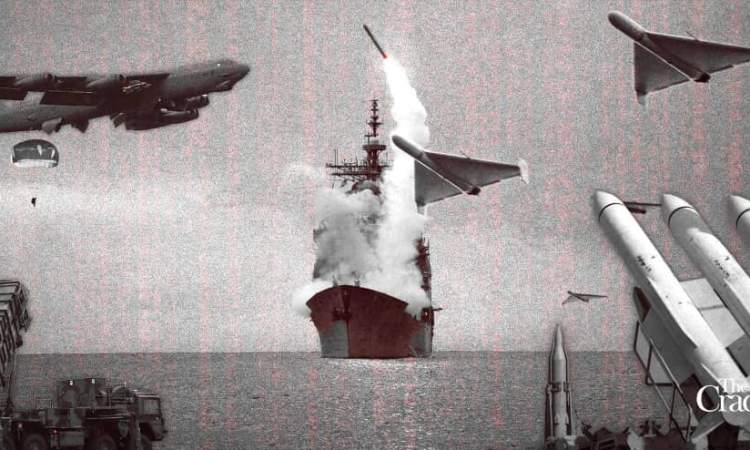
The American newspaper “The Cradle” stated that the US-Israeli war on Iran reveals an unprecedented drain on stockpiles of smart missiles, air defense systems, and high-value aircraft, at a cost exceeding tens of billions of dollars in just a few weeks.
The newspaper emphasized that the US-Israeli war on Iran exposed a deep structural crisis concerning the ability of the United States and Israel to sustain the fighting and replenish their stockpiles. During the initial weeks of operations, enormous quantities of missiles, aircraft, and smart bombs were consumed. According to a report issued by the Royal United Services Institute on March 24, 2026, the total number of munitions used during the first 16 days of the war reached 11,294, at a direct cost estimated at approximately $26 billion, while the cost of replenishment could exceed $50 billion, reflecting a rapidly widening gap between the ability to fire and the capacity to replenish them industrially.
However, the most significant figure emerged in the opening phase of the war; In just the first 96 hours, the coalition launched 5,197 munitions of 35 different types, making this campaign one of the most intense air operations in modern history. Detailed figures reveal the true extent of the strain on air defenses: in those four hours, US and Gulf batteries launched 943 Patriot missiles—a staggering number equivalent to approximately 18 months of continuous industrial production. The same applied to THAAD systems, of which about 145 missiles were used, representing more than a third of the estimated pre-launch stockpile. This transformed the situation from mere depletion into a structural imbalance in the strategic defense posture.
On the Israeli side, defenses faced unprecedented pressure, resulting in a more than 50% decrease in the Arrow missile stockpile within the first four days alone. It is estimated that replenishing this shortfall will require approximately 32 months of production. According to estimates, the munitions bill during those first 96 hours alone ranged between $10 billion and $16 billion, rising to $20 billion when aircraft and system losses were factored in. This pattern of rapid consumption led to the disabling or destruction of at least 12 radar and satellite stations, resulting in reduced interception efficiency and increased defense costs. It became necessary to launch 11 missiles to intercept a single target, or 8 Patriot missiles to intercept a single drone—an unsustainable drain on resources.
On the offensive side, the report revealed a massive consumption of ready stockpiles of long-range precision missiles. A staggering 225 MGM-140 ATACMS and PRISM missiles were used in the first four days alone. These surface-to-surface ballistic missiles are the backbone of deep surgical strikes. In parallel, the coalition launched more than 500 Tomahawk missiles over the course of 16 days, 375 of which were consumed in the initial phase alone. The strategic dilemma lies in the fact that replenishing this number of Tomahawks could take approximately 53 months, or more than four years of continuous industrial work. This would mean the loss of the capacity to replicate this pattern of intensive air operations in any future confrontation.
The depletion did not stop there. It extended to the arsenal of AGM-158 cruise and precision-guided air-to-surface missiles, hundreds of which were used to strike hardened Iranian radar and communications centers. Each missile costs more than a million dollars, and its production cycle is lengthy, dependent on the availability of complex electronic components that are currently subject to supply chain constraints. The report also noted the extensive use of HARM anti-radiation missiles to secure aircraft flight paths, which has dangerously depleted the stockpile allocated to the European theater of operations.
The newspaper revealed that this immense pressure on “smart” missiles presented the military leadership with a harsh reality. While the missiles were hitting their targets with tactical precision, they were depleting stockpiles of strategic assets that could only be replaced through years of industrial investment, creating a gap in global deterrence that money alone could not bridge.
Regarding operations against strategic targets and fortified installations, the report revealed the use of eight GBU-57 bombs—the most powerful conventional bunker-buster bomb, also known as the Massive Ordnance Penetrator—within the first 96 hours alone. These are the largest conventional bombs in the American arsenal, carried exclusively by B-2 Spirit bombs. At a cost of up to one million dollars each, these strikes depleted nearly a quarter of the available stockpile.
In parallel, the initial days witnessed what the report described as a “suicidal” consumption of small-diameter GBU-139 bombs, which were used extensively to strike mobile launch platforms, threatening quotas allocated to other global theaters of operation. The use of 2,000-pound BLU-109 “Earthquake” bunker-buster bombs continued relentlessly throughout the 16-day period, with this class of guided munitions costing billions of dollars.
The newspaper concluded by stating that the war on Iran reveals the fragility of US-Israeli military superiority when confronted with firepower capabilities similar to those possessed by Iran, both offensively and defensively, including missiles and drones. Despite their vast technological capabilities, the United States and Israel found themselves facing an unprecedented depletion of valuable munitions and aircraft.