
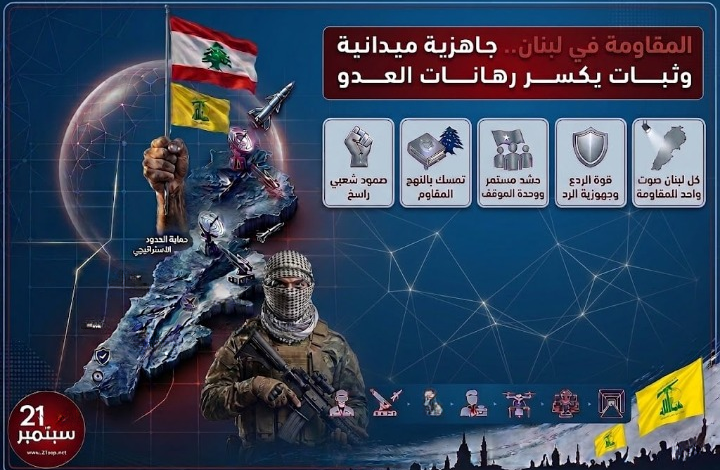
The Resistance in Lebanon: Field Readiness and Steadfastness that Shatters the Enemy’s Bets
Amidst the ongoing Zionist aggression and its repeated violations of the ceasefire agreement, the situation in Lebanon is moving towards greater cohesion in the resistance’s stance. The resistance affirms its field readiness while simultaneously rejecting reliance on any diplomatic avenues that have proven ineffective in curbing the aggression or protecting Lebanese sovereignty.
A Readiness That Doesn’t Wait
Hezbollah has clearly affirmed that the resistance is prepared to respond, and that the continued aggression will not be met with silence, but rather with direct confrontation in defense of the land and the people.
In this context, it emphasized that targeting enemy gatherings within the occupied territories and shelling its settlements comes within the framework of a legitimate response to more than 500 violations committed by the enemy since the declaration of the truce. These violations have included bombings, destruction, and attacks targeting civilians. This position reflects a clear shift towards establishing a deterrent equation based on constant readiness, far removed from any waiting for uncertain political outcomes.
The Failure of Diplomatic Bets
Politically, Hezbollah sharply criticized the Lebanese authorities regarding the so-called negotiations with the enemy entity, arguing that they failed to achieve even the minimum protection for Lebanon and instead provided the enemy with cover to continue its repeated attacks and violations.
Hezbollah emphasized that any agreement or understanding used to justify the enemy’s continued aggression or violations is unacceptable, stressing that Lebanon was not a party to any agreement that permits such practices by the enemy. It added that relying on mediation or political meetings did not stop the aggression but rather encouraged the enemy to persist in its violations, at a time when a clear and decisive stance should have been taken to halt the attacks and protect sovereignty.
The Field Speaks: On the ground, the resistance continues its qualitative operations, announcing attacks on enemy troop concentrations and evacuation forces in the town of Taybeh, inflicting confirmed casualties, in response to the ongoing attacks on southern villages. These operations confirm that the initiative remains with the resistance and that it is capable of imposing new realities on the ground, despite all attempts at military and political pressure.
Confusion Within the Enemy Entity: Meanwhile, enemy media reports reflect a state of escalating anxiety within the Zionist military establishment, given the failure to achieve the war’s objectives.
These reports indicate the continued presence of resistance fighters within the confrontation zones and their execution of operations, reflecting a high capacity for adaptation and attrition. Signs of an internal crisis have also emerged, with a rise in suicides among enemy soldiers, indicating the extent of the psychological pressure and the inability to decisively win the battle.
A New Equation
In conclusion, a clear picture is emerging in Lebanon: a ready resistance and an active field, versus an enemy in crisis politically and militarily. A new equation is emerging, the essence of which is that protecting sovereignty can only be achieved through force, and that resistance has become the most realistic option in confronting aggression. Between the continuation of violations and the failure of political bets, it seems that the next stage will remain open to further confrontation, in light of the resistance’s insistence on establishing new rules of engagement imposed by the will of the field.