
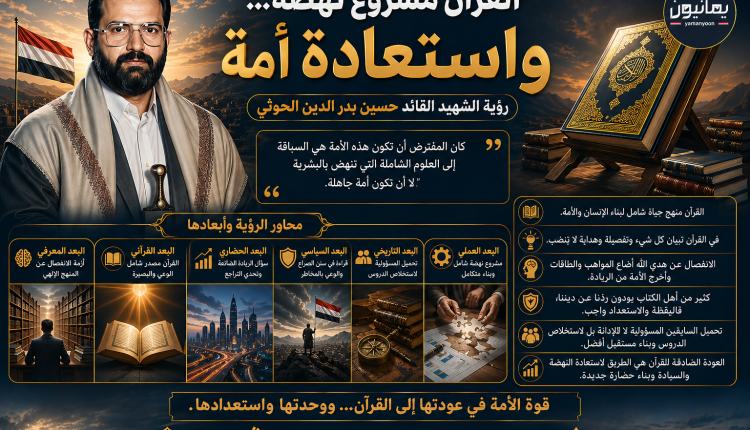
The Quran: A Project for the Revival and Restoration of a Nation
Within an intellectual framework that transcends traditional preaching, the profound vision of the martyred leader emerges as one of the most important intellectual projects that sought to reshape the nation’s consciousness based on the Holy Quran, not merely as a devotional text, but as a comprehensive way of life. The sixth lesson of Ramadan reveals a number of profound dimensions that touch upon the core of the civilizational dilemma facing the Islamic nation, pinpointing the sources of its historical and contemporary shortcomings.
The Crisis of Separation from the Divine Path
The martyred leader begins with a central premise: that the decline of the nation is not due to a lack of resources, but rather to its separation from the primary source of guidance, the Holy Quran. He offers a sharp critique of the unproductive accumulation of knowledge, where, under this separation, sciences become marginal knowledge that does not serve the nation’s major issues, intellectual efforts are wasted on fruitless paths, and human potential is drained without any real civilizational impact. Herein lies a profound vision that considers the problem not to be the “quantity of knowledge” but rather the “direction of knowledge”—a proposition that touches upon contemporary debates in the philosophy of science regarding the usefulness and function of knowledge.
The Quran as a Comprehensive Source of Awareness
The martyr of the Quran emphasizes its comprehensiveness as a complete source of knowledge, “an explanation of all things,” and a source for building awareness and insight, and an alternative to limited human interpretations. The martyr leader introduces an important concept: that the Quran is not merely a book of individual guidance, but rather a complete civilizational project capable of producing a conscious individual with a comprehensive vision of life. This vision restores the concept of the “supreme authority of the Quranic text,” in contrast to the excessive reliance on human theories that may deviate from the divine path.
The Question of Lost Leadership
One of the most prominent implications of the text is the problem of lost civilizational leadership. It indicates that the Muslim nation was supposed to be at the forefront of nations scientifically and intellectually, but reality reflects the opposite. This prompts fundamental questions:
Why did other nations surpass them in the fields of science and technology?
Where were the Muslims during the major turning points in history?
Was this decline inevitable, or the result of poor choices? The answer offered by the martyred leader rests on the historical neglect of the Quranic methodology, which has led to a loss of civilizational direction.
A Reading of the Laws of Conflict
The martyred leader of the Quran clearly addresses the nature of the relationship with the “enemy,” especially within the context of civilizational conflict, relying on the verse: {Many of the People of the Scripture wish…}. He presents an analysis based on several pillars,
most notably that the conflict is not a recent occurrence but rather rooted in the internal motivations of the other side; that targeting is not linked to immediate behaviors as much as it is to identity and affiliation; and that internal weakness opens the door to external hegemony. He also points out that appeasement or silence does not change the nature of this conflict, but may even reinforce a state of dependency.
Assigning Historical Responsibility
It is intellectually bold to assign a portion of responsibility to those who came before us, especially those who witnessed the beginnings of the Western Renaissance. Here, the critique is not intended as condemnation, but rather as a means to draw historical lessons, dismantle the causes of decline, and prevent the repetition of mistakes. This approach underscores that self-criticism is a fundamental prerequisite for any genuine renaissance.
Calling for a Comprehensive Renaissance Project
The martyred leader does not merely diagnose the situation; he calls for a practical path forward. This path entails a serious return to the Quran as a source of guidance, the establishment of a strong scientific foundation rooted in identity, the strategic investment of energies and talents, and preparation to confront civilizational challenges. This reflects a shift in discourse from preaching to action, from theorizing to change.
In conclusion…
In this vision, the martyred leader presents a comprehensive intellectual project that seeks to rebuild the individual and the nation on conscious Quranic foundations. Its most prominent features include: redefining knowledge in its civilizational function; emphasizing the centrality of the Quran in shaping consciousness; deeply understanding the laws of conflict and history; and calling for a renaissance based on awareness and responsibility. In light of current global transformations, this vision acquires increasing importance as a serious attempt to answer a fundamental question: How can the nation reclaim its civilizational role?