
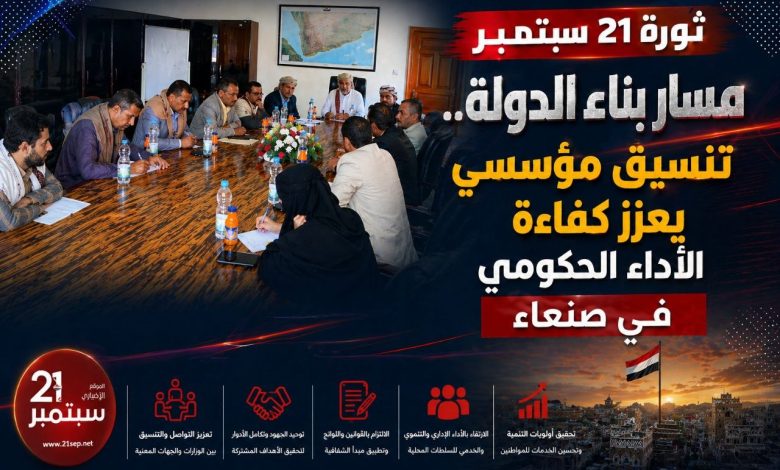
The September 21 Revolution: A Path to State-Building – Institutional Coordination Enhances Government Performance in Sana’a
Within the framework of the reform process initiated by the September 21 Revolution, efforts continue to strengthen institutional performance and develop mechanisms for collaboration among government entities. This aims to improve public services and achieve more efficient development that is responsive to citizens’ needs.
In this context, a meeting held today in Sana’a, chaired by Deputy Minister of Local and Rural Administration and Development, Nasser Al-Mahdhar, discussed a project to enhance communication and coordination between the Ministries of Local Administration and Development, Culture and Tourism, and the Capital Secretariat. This step reflects a practical approach to developing institutional coordination.
Enhancing Institutional Communication
The meeting, which was attended by the Director of the Communication Enhancement Project at the Ministry, Khalil Al-Quraishi, and several representatives from the Ministry of Culture and Tourism and the Capital Secretariat, reviewed the project document. The document aims to activate communication channels between central and local government bodies. This initiative is part of an effort to improve coordination among various entities, thereby supporting administrative and developmental performance and contributing to the efficient and effective implementation of shared tasks.
Legal Commitment and Administrative Integration
The participants emphasized the importance of adhering to the Local Authority Law and other applicable laws and regulations, considering them the foundation for regulating relations between government entities. This strengthens institutional discipline and ensures clarity of roles and responsibilities. They also stressed the need to enhance communication mechanisms between different administrative levels, which will positively impact the speed of work completion and improve the quality of services provided to citizens.
Joint Coordination for Development
The meeting discussed the importance of arranging a joint meeting between the leadership of the Ministry of Culture and Tourism and the Capital Governorate, under the supervision of the Ministry of Local and Rural Development, to follow up on the implementation of the project’s tasks and translate its outputs into practical steps. This approach is part of a broader strategy to enhance integration among government entities, contributing to achieving local development priorities and improving institutional performance.
A Continuous Approach to State-Building
These steps reflect a clear trend towards consolidating organized institutional work, a key feature of the phase brought about by the September 21 Revolution, which prioritized developing government performance and strengthening coordination among state institutions. Improving communication mechanisms between different entities is a fundamental pillar in building a more efficient administrative apparatus capable of responding to development requirements and improving the level of public services.
Towards Institutional Building
This institutional movement reflects a practical approach to consolidating integration among government agencies and enhancing the effectiveness of administrative work by developing coordination and communication mechanisms that keep pace with the requirements of the current phase. It represents a step towards building a more efficient administrative apparatus capable of improving the level of services and meeting citizens’ needs. The project affirms that organized institutional work and joint coordination constitute a fundamental pillar in developing government performance, in line with the path of the September 21 Revolution in building the state and strengthening the efficiency of its institutions.