
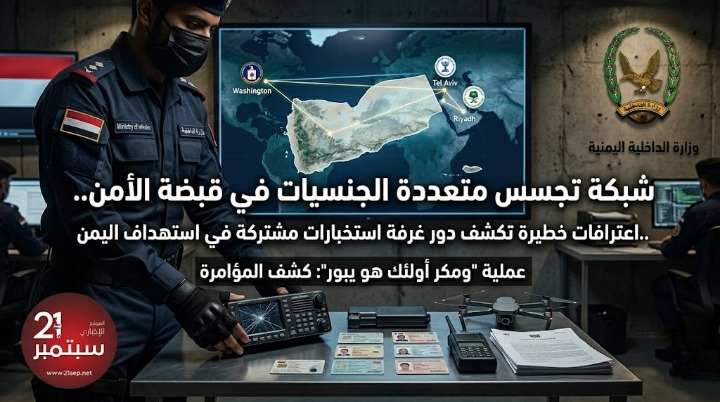
A multinational spy network has been apprehended by security forces. Dangerous confessions reveal the role of a joint intelligence room in targeting Yemen.
In a highly significant security development that underscores the scale of the challenges facing Yemen due to its unwavering and principled stance on the Palestinian cause, the Ministry of Interior announced new details and confessions from members of a spy network linked to a joint intelligence room comprising American, Israeli, and Saudi agencies. This network was a blatant attempt to target the Yemeni home front and pressure it to cease supporting the Palestinian people in Gaza.
This announcement is not merely a routine security matter, but rather part of an open battle being waged by Yemen on multiple levels, where military, intelligence, and media fronts intersect. This battle is taking place against the backdrop of Yemen’s escalating role in supporting Gaza, a role that represents a strategic threat to the enemy.
A High-Profile Operation Uncovers the Threads of the Conspiracy
The Ministry of Interior explained that these confessions come within the framework of the high-profile security operation, “And their plot will come to nothing,” which, with God’s help, succeeded in dismantling a complex spy network operating under the direct supervision of a joint intelligence room based in Saudi Arabia. This network included elements from US intelligence, the Israeli Mossad, and Saudi intelligence agencies.
The operation was not limited to arresting the operatives; it also uncovered a comprehensive intelligence system upon which the enemy relied to gather sensitive information about Yemen, particularly during the period of Yemeni support for Gaza. This reflects the extent of the enemy’s interest in Yemen’s movements and their impact on the course of the regional confrontation.
Dangerous Intelligence Missions and Direct Targeting of Facilities
The confessions revealed by the Ministry of Interior showed the network members’ involvement in carrying out precise intelligence missions, including surveillance, gathering sensitive information, and transmitting the coordinates of vital, security, and military sites to the enemy’s joint operations room.
According to the statement, this information was already used in attacks targeting Yemeni facilities, resulting in casualties and injuries—a dangerous indication of the extent of the damage such networks can inflict.
Sophisticated Recruitment Methods… From Riyadh to the Yemeni Interior
One of the most significant revelations from the confessions was the systematic approach adopted by the enemy to attract and recruit operatives. Mercenaries and intermediaries were used to target individuals within the military establishment or those with access to sensitive information.
Some recruits were summoned to the Saudi capital, Riyadh, where they underwent direct meetings with Saudi and foreign intelligence officers and were provided with tools and techniques used in espionage. This reveals the level of organization and planning behind this network.
Soft Infiltration Through Society and Relationships
The statement also indicated that the network did not rely solely on direct methods but resorted to what is known as soft intelligence, exploiting public gatherings and social events to obtain information indirectly.
The operatives also worked to cultivate relationships with government employees, or even their relatives, to gain access to data concerning military capabilities, leadership movements, meeting schedules, and work and residence locations. This reflects a deep attempt to infiltrate the social and administrative fabric.
The Significance of the Timing: Targeting Yemen’s Stance on Gaza
The timing of the exposure of this network, and the confessions associated with it, carries clear political and strategic implications. It coincides with the escalating Yemeni role in supporting Gaza, both militarily and on a popular level.
This confirms that the enemy—unable to break the Yemeni will on the battlefield—is resorting to its intelligence tools to try to weaken the home front and create security breaches that can be exploited to influence sovereign decisions and political stances.
Security Readiness and a Message of Deterrence
In its concluding statement, the Ministry of Interior affirmed that it is at the highest levels of readiness and vigilance, and that it will spare no effort in fulfilling its national duty to confront all conspiracies targeting Yemen’s security and stability.
The statement also carried a clear message: security forces continue their highly efficient work in monitoring, tracking, and thwarting subversive activities, and any attempts to undermine the country’s security will be met with decisive action.
In summary, the Interior Ministry’s revelations highlight a dangerous aspect of the war being waged on Yemen—a war not limited to airstrikes or blockades, but extending to attempts at infiltration, espionage, and sabotage from within.
Conversely, this high-quality security operation reflects the advanced level of Yemeni security performance and its ability to uncover and thwart complex plots, despite the magnitude of the challenges.
While Yemen maintains its principled stance in supporting Gaza, the tools of pressure employed by the enemy are gradually being revealed in what appears to be a protracted battle. However, as events confirm, this battle is governed by a steadfast will and growing awareness, transforming every conspiracy into an additional opportunity to strengthen resilience and steadfastness.