
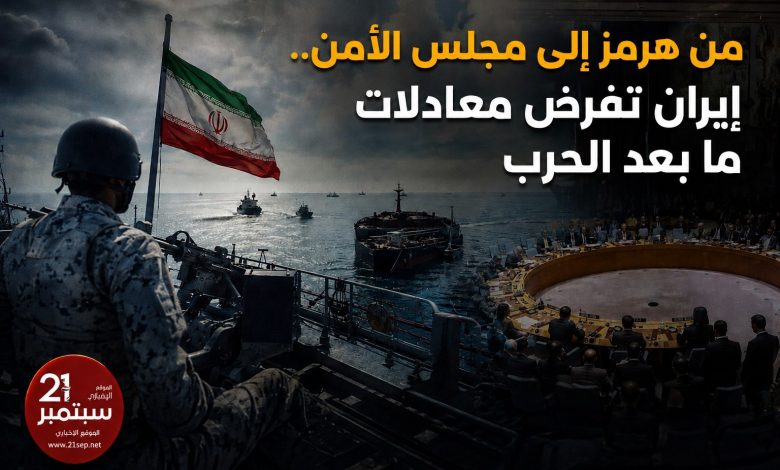
From Hormuz to the Security Council: Iran is shaping the post-war equations.
Iran continues to establish new equations in the post-American-Zionist war phase, through a gradual political and military escalation that confirms that the Strait of Hormuz is no longer as it was before the last confrontation, and that any regional or international arrangements related to the world’s most important maritime passage will not pass without Iranian consent.
In parallel with Western moves within the Security Council, Tehran raised the bar on its warnings, stressing that any new escalation or attempt to impose facts on the ground by force would be met with a broad response, holding Washington and its allies fully responsible for any potential explosion in the region.
Warning against the Washington project
In this context, Iran’s mission to the United Nations asserted that the United States, through the draft resolution on the Strait of Hormuz, is seeking to provide political cover for its military actions and to try to demonstrate broad international support for its policies in the region.
The mission warned that countries adopting the American project will bear international responsibility alongside Washington for any repercussions or new escalation that the region may witness, stressing that no diplomatic cover will exempt those countries from the consequences of supporting “American aggression.”
This comes amid US and Gulf pressure within the Security Council to pass a draft resolution on “securing the Strait of Hormuz,” after amending the original draft which included references to the use of force against Iran.
Hormuz… a new Iranian administration
In parallel with the political battle, Tehran is proceeding to impose a new reality on the ground within the Strait of Hormuz, as the head of the National Security Committee in the Iranian Shura Council, Ibrahim Azizi, announced that his country has prepared a new “professional mechanism” for managing maritime navigation in the strait, which will be revealed soon.
He explained that the new mechanism will include providing specialized services to commercial ships and countries cooperating with Iran, in addition to imposing fees for those services, stressing that the Strait of Hormuz will remain closed to the so-called “Freedom Project” promoted by Washington.
In the same context, Iranian television revealed that European ships had entered into direct negotiations with the Revolutionary Guard Navy to secure their passage through the Strait, amid assurances that all ships were now coordinating with the Iranian naval forces to ensure a safe and orderly passage.
Messages of strength and constant readiness
Militarily, the Iranian Interior Ministry stressed that the readiness of the Iranian armed forces today is greater than it was at the beginning of the war, confirming that Iran is capable of thwarting any American or Zionist moves in international waters.
Ministry spokesman Ali Zeinivand stressed that the Islamic Republic is not susceptible to siege, and that internal and border security is stable, while military preparations continue in anticipation of any new developments on the ground.
These statements reflect Tehran’s adherence to the option of deterrence, in light of continued regional tensions and Washington’s attempts to rearrange the security landscape in the Gulf after its failure to impose the equations of war.
Iran is committed to dialogue and sovereignty.
Politically, Iranian President Masoud Pezeshkian sent a message to Pope Leo XIV, thanking him for his stances rejecting the American-Israeli aggression against Iran, stressing that what was issued by US President Donald Trump regarding “destroying Iranian civilization” reflects a mentality of arrogance and the illusion of power.
Pezeshkian explained that the targeting of American interests came as a result of the use of military bases in some Gulf countries to attack Iran, while stressing that his country does not seek to threaten its neighbors, but rather affirms its desire to build stable and secure relations with the countries of the region.
The Iranian president also stressed that his country remains committed to diplomacy and peaceful solutions, while fully reserving its legitimate right to defend its sovereignty and interests.
New equation
Iranian political and military moves reveal a clear trend to establish a new equation in the Strait of Hormuz, based on the premise that the security of navigation and the management of maritime routes cannot be separated from the Iranian role and the interests of the Islamic Republic, as the most present and influential power in regional security equations.
In light of the American escalation and attempts to internationalize the issue within the Security Council, Tehran appears to be proceeding with establishing post-war realities by combining military deterrence with diplomatic action, reflecting