
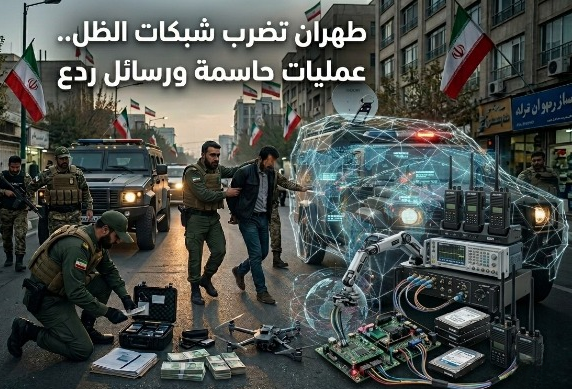
Tehran strikes shadow networks: decisive operations and deterrent messages
Iran continues to escalate its security and political confrontation with the United States and the Zionist entity, amid rising regional tensions following the recent war, by pursuing internal espionage and sabotage networks, in parallel with political and military messages confirming that the Islamic Republic has become stronger and more steadfast in the face of external pressures and threats.
Iranian statements and actions over the past few hours reflect a clear trend towards strengthening the home front and continuing to consolidate regional deterrence equations, at a time when Tehran is talking about the failure of American and Zionist projects to break its will or weaken its influence in the region.
Strike spy networks
In this context, the Iranian Revolutionary Guard’s intelligence service announced the arrest of a number of elements linked to the American and Zionist enemy in several Iranian provinces, who were planning to incite chaos and harm internal security and the national economy.
The agency confirmed that its forces in Qazvin province were able to arrest two spies linked to the Zionist entity, in addition to dismantling a weapons distribution network and seizing quantities of ammunition and war weapons.
The Revolutionary Guard intelligence also announced the seizure of 1,400 tons of petrochemical raw materials stored with the aim of harming the market and causing economic turmoil, in a move that reflects the scale of the economic and security war the country is facing.
In Kerman province, security forces arrested eight individuals involved in terrorist acts, shootings, and espionage for the Zionist entity, while in Chaharmahal and Bakhtiari province, networks linked to hostile groups that were planning to carry out acts of sabotage and incite chaos were dismantled.
In parallel, the commander of the Iranian Internal Security Forces, Brigadier General Ahmad Reza Radan, announced the arrest of more than 6,500 spies and traitors since the beginning of the “third imposed war,” stressing the continuation of security operations to pursue elements linked to the enemy and rioters.
Messages of strength and warnings to Washington
Politically and militarily, Iranian leaders continued to send sharp messages to the United States, with Major General Mohsen Rezaei, a member of the Expediency Discernment Council, asserting that America had suffered a “strategic defeat” as a result of Iran’s steadfastness and resistance.
Rezaei stressed that the Iranian armed forces are capable of breaking any naval blockade, warning that the Sea of Oman could turn into a “graveyard for American ships” if Washington continues its escalating policies.
He pointed out that Iran views any naval blockade as an act of war, stressing that Tehran will not allow equations to be imposed that threaten its sovereignty or strategic interests.
He also considered that the decline of the United States in the region has become clear, in light of the failure of military and political pressures, and the increasing American need for major international powers, especially China.
No animosity with the neighbors
In contrast, the Iranian Foreign Ministry stressed that Tehran harbors no animosity towards the countries of the region and seeks to strengthen cooperation with neighboring countries, asserting that the American presence is the primary factor in destabilizing the security and stability of the region.
Iranian Foreign Ministry spokesman Ismail Baghaei said that experience has proven that American interventions do not bring security, but rather open the doors to chaos and tensions, calling for the building of a regional security system based on cooperation and trust between the countries of the region, away from foreign interventions.
Baqaei pointed out that some recent regional moves have encouraged the Zionist entity to continue its crimes, stressing that Iran is monitoring developments cautiously and adheres to the option of strengthening regional stability through dialogue and cooperation.
The resistance lives on
In a related context, the commander of the Quds Force in the Iranian Revolutionary Guard, Brigadier General Ismail Qaani, confirmed that the assassination of the commander of the Qassam Brigades’ General Staff, Izz al-Din al-Haddad, proves that the resistance is still alive and rooted in the heart of Gaza despite the ongoing aggression.
Qaani stressed that the blood of the martyred leaders will remain fuel for the Palestinian resistance and a source of inspiration for future generations until the liberation of Jerusalem and the demise of the Zionist entity.
Iranian Parliament Speaker Mohammad Baqer Qalibaf also considered that the assassination of Haddad during the truce period reveals once again the nature