
Al-Jawf, Yemen’s Breadbasket: A Million Sacks of Wheat Embody the Fruits of the September 21 Revolution and Break the Chains of Dependence
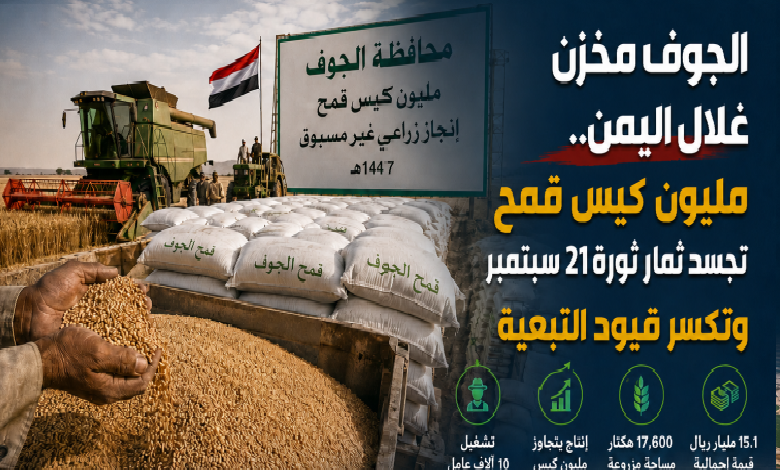
Amid the challenges of aggression and blockade facing Yemen, Al-Jawf Governorate stands as a living example of national will and resilience, achieving an unprecedented agricultural feat by recording a record production exceeding one million sacks of wheat for the 1447 AH agricultural season.
This achievement is not merely a number in production records, but a qualitative leap towards achieving food security and breaking the chains of dependence on foreign powers. It is a practical embodiment of the principles of the September 21 Revolution, which liberated Yemeni decision-making and freed the country from the yoke of foreign tutelage.
Al-Jawf, which for many years was targeted by chaos and marginalization, has transformed into Yemen’s breadbasket, thanks to the directives of the revolutionary leadership and the sincere efforts of its farmers. This confirms that the battle for sovereignty begins on the land and extends to independent national decision-making.
This report reviews the features of this agricultural renaissance, documents the figures and achievements, and highlights the pivotal role of the September 21 Revolution in this strategic transformation. Numbers Speak: A Qualitative Leap Towards Self-Sufficiency
The head of the agriculture sector in Al-Jawf Governorate, Mahdi Al-Dhamin, announced a strategic success for the 1447 AH agricultural season, with wheat production exceeding one million sacks.
Field statistics compiled so far confirm that total production reached 1,021,901 sacks of wheat, with a total value of 15.1 billion Yemeni riyals.
This achievement was not limited to production alone, but extended to the economic and social spheres, as it provided employment for approximately 10,000 workers this season, benefiting tens of thousands of rural families and contributing to improving their standard of living.
Al-Dhamin points out that these figures represent only the collected and processed data, emphasizing that the actual total production for the governorate far exceeds these numbers, given the incomplete data from two districts, in addition to very large quantities of wheat for which detailed data has not yet been received. All of this confirms that Al-Jawf has indeed become the breadbasket of Yemen, and that its agricultural potential surpasses all expectations. The September 21 Revolution: The Engine of Agricultural Renaissance
This agricultural renaissance was not a coincidence, but rather the fruit of the directives of the revolutionary leadership, represented by Sayyid Abdul-Malik Badr al-Din al-Houthi, who repeatedly emphasized that agriculture is the “backbone of the economy” and the “first economic front” in confronting aggression and the blockade.
The September 21 Revolution came to break the shackles of foreign control that had prevented Yemen from utilizing its fertile lands for wheat cultivation and imposed dependence on imports.
This approach was embodied in unprecedented support for the agricultural sector through the “Supreme Agricultural and Fisheries Committee” and the “Ministry of Agriculture, Fisheries, and Water Resources,” in cooperation with active institutions such as the “General Corporation for Grain Development and Production” and the “Bunyan Development Foundation.” These entities worked to provide improved seeds, technical and advisory support to farmers, and harvesting equipment, in addition to purchasing crops at incentive prices to protect them from price gouging by merchants.
Al-Jawf: From Marginalization to Leadership
Al-Jawf Governorate possesses immense natural resources that qualify it to be the breadbasket of Yemen. Approximately 75% of its land is suitable for agricultural reclamation, equivalent to more than two million hectares capable of cultivating the finest crops.
After security and military forces succeeded in normalizing the security situation and establishing stability throughout the governorate, hundreds of farmers and investors flocked to Al-Jawf, leading to an unprecedented investment boom.
The area cultivated with wheat has increased significantly. From approximately 7,000 hectares in previous years, it has now reached nearly 17,600 hectares.
Successful examples of investment farms include the “In’am Yemen” farm and the “Al-Sunaid” farm, in addition to the active role of agricultural cooperatives, such as the “Al-Matun” cooperative, which has achieved success in producing pure seeds. The Battle of Awareness and Resilience
This achievement would not have been possible without the high level of awareness among the farmers in the governorate, whom the head of the agricultural sector in Al-Jawf described as the soldiers of the agricultural front.
Their awareness was embodied in achieving a high rate of loan repayment, ensuring the sustainability of support and the continuation of production for future seasons.
Despite the significant challenges faced by farmers, including agricultural pests and a shortage of harvesting equipment, the combined efforts of agricultural associations, the agricultural office, and the plant protection unit in the governorate, with the support of relevant institutions, contributed to overcoming these threats and providing the necessary pesticides and harvesters.
Conclusion:
The agricultural renaissance in Al-Jawf Governorate, and the record wheat production achieved there, is a shining testament to Yemen’s ability to achieve self-sufficiency and withstand challenges. It is a victory for the national will embodied in the September 21 Revolution, and a giant step towards liberation from economic dependency. Al-Jawf today is not just a wheat-producing governorate, but a symbol of national sovereignty, and a clear message to the world that Yemen, which has withstood military aggression and siege, is capable of winning the battle for food and sovereignty, confirming the immortal saying: “He who does not eat from his own food does not own his decision.”