
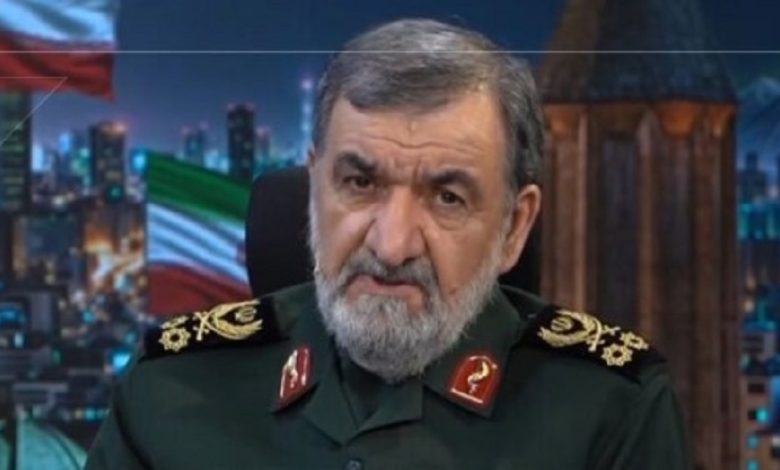
Rezaei: Any aggression against the southern suburbs of Beirut will turn northern occupied Palestine into hell.
Major General Mohsen Rezaei, military advisor to the Supreme Leader of the Islamic Revolution in Iran, affirmed that the Islamic Republic is fully prepared to respond forcefully to any Zionist aggression targeting the southern suburbs of Beirut, stressing that Iran’s hand is still on the trigger and that it will not abandon its allies in the face of American and Zionist threats.
Rezaei said in televised remarks that the Zionist enemy was about to face an unprecedented response if it had targeted the southern suburbs, stressing that just one step towards the suburbs would have been enough to turn the northern occupied Palestinian territories into hell, with a force many times greater than what was witnessed in the forty-day war, explaining that all the missiles were in a state of full readiness to deal with this scenario.
Major General Rezaei reiterated his warning to the Zionist enemy entity against continuing its attacks and aggressive policies in the region, calling on it to withdraw from Lebanon quickly, and stressing that the capabilities of the resistance axis are still present and ready to respond to any escalation.
Rezaei stressed that Tehran would not abandon its allies, saying: “If Iran does not defend its allies and friends today, no one will come to its aid tomorrow,” referring to the Islamic Republic’s commitment to supporting resistance forces in the region against American and Zionist projects.
In a related context, Rezaei threatened the United States and the Zionist enemy entity with another blow that would bring both sides back to their true size, unless they act rationally and stop their policies of hegemony and aggression, stressing that the deterrence equations imposed by Iran and the axis of resistance have become a reality that cannot be ignored.
General Rezaei addressed the regional situation, noting that the Emir of Qatar and the Saudi Crown Prince, Mohammed bin Salman, have begun to adapt to the new changes in the region and align their positions with the emerging reality, considering that some other Gulf regimes are still betting on the continuation of American influence in the same form that existed during the past decades.
Rezaei criticized the positions of the UAE, Bahrain and Kuwait, warning against any continued cooperation or coordination with the Zionist enemy entity, and stressing that the Islamic Republic will not stand idly by in the face of any steps that affect the security of the region or serve the occupation projects.
Regarding international navigation, Rezaei stressed that the Strait of Hormuz will remain open to global trade, but it is not a passage for foreign military presence or for imposing a blockade on the peoples of the region, noting that dozens of commercial ships cross the strait daily, and that the United States must abandon its policies of blockade and military escalation.
Major General Mohsen Rezaei concluded his remarks by emphasizing that the Strait of Hormuz has become one of the most important strategic deterrent cards in the region, noting that Western experts have described its strategic impact as equivalent to the power of “ten nuclear bombs,” referring to the pivotal position that the strait occupies in global security and energy equations.