
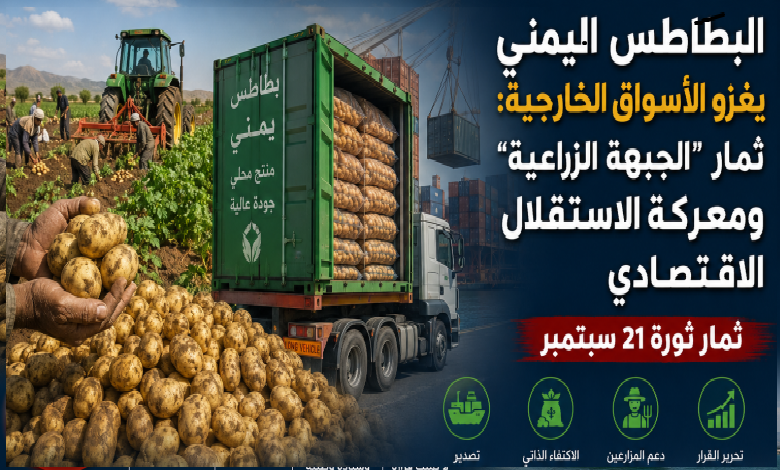
Yemeni potatoes conquer foreign markets: The fruits of the “agricultural front” and the battle for economic independence
In a historic step that embodies the most glorious image of victory in the battle for sovereignty and liberation from dependency, the Ministry of Agriculture, Fisheries and Water Resources, represented by the Agricultural Marketing Sector, and in coordination with the concerned authorities, has begun procedures to export the surplus of local potato production to foreign markets.
This strategic achievement is not just a business transaction, but a ripe fruit of the blessed September 21 revolution, which liberated the Yemeni decision from the cloak of foreign guardianship, and restored Yemen’s status as a country capable of feeding itself and exporting its surplus production to the world with an independent sovereign decision.
The September 21 Revolution: Breaking the shackles of dependency and liberating agricultural decision-making.
Before the September 21 revolution, Yemen was burdened by systematic policies aimed at destroying the agricultural sector and keeping the country hostage to imports and foreign guardianship. With the dawn of the revolution, this constraint was shattered, and Yemen embarked on the path of building a sovereign economy, based on a Qur’anic vision and divine leadership that made agriculture the “first economic front.”
Today’s export of surplus potatoes is a clear testament to the fact that Yemen, whose political decision-making was liberated on September 21st, is confidently moving towards achieving full economic liberation. After decades of dependence on foreign powers, even for basic necessities, Yemen, thanks to the resilience of its people and the guidance of its leadership, is now transforming from an importer of seeds and produce to a producer and exporter, thus shattering all the schemes aimed at subjugating the Yemeni people through starvation and blockade.
From self-sufficiency to export: The success story of Yemeni potatoes
In this regard, the Undersecretary of the Ministry for the Agricultural Marketing Sector, Mohsen Atef, explained that the decision to export the surplus comes as a direct result of the large abundance in potato production, which was achieved thanks to the success in reaching self-sufficiency in potato seeds.
This qualitative achievement in providing local seeds, which was a distant dream under the previous trusteeship system, directly contributed to increasing production and achieving a surplus that could be marketed abroad .
This step has profound economic and social dimensions; it contributes to achieving balance in local markets, protects farmers from price collapse, enhances the stability of the agricultural market, supports the sustainability of production, and transforms agriculture into an attractive sector for investment and a real source of national income .
Manufacturing industries: A promising opportunity awaiting investment
The discussion wasn’t limited to exports; it extended to an explicit call for the private sector to capitalize on this surplus. The Undersecretary of the Marketing Sector emphasized that the current production represents a promising investment opportunity for expanding agricultural processing industries related to potatoes, such as the production of frozen potatoes and their derivatives. These industries, characterized by their high economic viability and low investment requirements, are capable of absorbing a significant portion of the production surplus, increasing the added value of local products, creating new job opportunities, and supporting comprehensive economic development.
Protecting local products: A battle of awareness and decision against reckless imports
While we celebrate this achievement in potato exports, we cannot ignore the stark contradiction that continues to threaten self-sufficiency in other crops and products. While the leader, Abdul-Malik Badr al-Din al-Houthi, consistently calls for increased domestic production and an end to the drain on foreign currency reserves, the specter of reckless imports continues to loom over certain sectors, jeopardizing the efforts of local farmers and manufacturers.
Perhaps the most prominent example of this is the continued importation of “Indian mango pulp,” which represents a wound in the body of the national economy, despite the existence of abundant and high-quality Yemeni production, and the existence of local factories capable of meeting the need.
This unjustified importation causes farmers and local traders to suffer heavy losses, and leads to the accumulation of local products, as happened in the mango factory in Bajel, which incurred losses of billions of riyals after thousands of tons of local mango pulp accumulated due to unfair competition from the imported p