
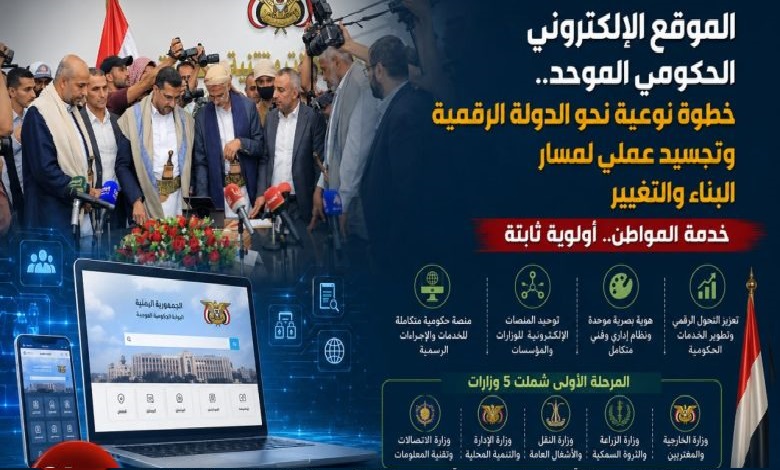
The Unified Government Website: A Qualitative Step Towards a Digital State and a Practical Embodiment of the Development and Transformation Process
In a new achievement added to the institutional development and administrative reform process underway in the Republic of Yemen, Acting Prime Minister Mohammed Muftah inaugurated the unified government website project. This strategic step reflects the state’s commitment to enhancing digital transformation, developing government services, and simplifying procedures for citizens, keeping pace with the demands of the current phase and boosting the efficiency of institutional performance across all government agencies.
The launch of this project represents a significant milestone in the administrative modernization process adopted by the government of change and development. It is a practical embodiment of the national vision aimed at building modern institutions capable of providing services to citizens efficiently, transparently, and easily, despite the exceptional challenges imposed by the aggression and blockade over the past years.
Digital Transformation: From Vision to Implementation
This project comes within the framework of the Ministry of Communications and Information Technology’s strategic direction towards building an integrated government digital infrastructure. This infrastructure is based on unifying the electronic platforms of ministries and government institutions under a unified identity and an integrated administrative and technical system, contributing to the development of institutional performance and enhancing coordination among various government entities.
During the launch, Sheikh Mohammed Muftah emphasized that the unified website represents a comprehensive government platform for official services and procedures. It allows citizens to access government services and complete their transactions easily and conveniently, saving time and effort and enhancing the quality of services provided.
The project embodies one of the most important requirements of a modern state, contributing to the digitization of numerous procedures and services. This reduces administrative complexities, accelerates processes, and raises the level of efficiency and effectiveness in government performance.
Serving the Citizen: A Constant Priority in the Path of the September 21 Revolution
Since the launch of the September 21 Revolution, serving the citizen and improving the level of public services has been a fundamental pillar of the national liberation project. The revolutionary and political leadership has worked to establish the concept of a state that protects the interests of its citizens and is capable of meeting their needs, despite the exceptional circumstances imposed by the aggression and blockade.
The launch of the unified government website is an extension of this approach, serving as a practical tool to bring services closer to the citizen and facilitate their access without complications or obstacles. This aligns with a vision aimed at building more efficient, effective institutions that are responsive to the needs of society.
The project also reflects the significant attention the state is giving to developing the technology and digital sector, considering it a vital sector that represents a fundamental pillar in the development process, administrative reform, and enhancing government performance.
Five Ministries in the First Phase
The first phase of the project included five ministries: the Ministry of Foreign Affairs and Expatriates, the Ministry of Agriculture, Fisheries, and Water Resources, the Ministry of Transport and Public Works, the Ministry of Local and Rural Administration and Development, and the Ministry of Communications and Information Technology.
The Acting Prime Minister emphasized the necessity of completing the integration of the remaining ministries and government entities into the unified website during the new Hijri year 1448 AH, thus achieving comprehensive integration of the government’s digital system and enhancing the effectiveness of electronic services provided to citizens.
The project aims to unify data entry mechanisms and the dissemination of government content within a unified framework and visual identity, while preserving the privacy of each government entity and highlighting the nature of its competencies and tasks. This contributes to organizing institutional work and developing modern e-government mechanisms.
Cybersecurity in the Face of Threats
In light of the rapid developments in the global digital space, the project has given special attention to cybersecurity and the protection of government data. In this context, Allama Muftah emphasized the importance of protecting the unified government website’s data from cyberattacks, especially given Yemen’s ongoing confrontation with the Zionist enemy and the accompanying attempts to target the digital infrastructure and information systems of countries and institutions.
He pointed out that many countries in the region have become vulnerable to cyberattacks and technological penetration targeting their banking and institutional systems and databases. This necessitates the development of advanced protection systems capable of safeguarding national data and preserving its security and digital sovereignty.
This approach reflects a progressive understanding of the importance of cybersecurity as an integral part of national security and sovereignty in the modern era.
Unified Government Identity and Enhanced Institutional Integration
For his part, the Minister of Communications and Information Technology, Engineer Mohammed Al-Mahdi, explained that the unified government website represents a comprehensive national project to unify government websites and electronic platforms under a single identity and enhanced cybersecurity.
He emphasized that the project aims to empower government entities to manage and operate their websites with high efficiency, unify the mechanisms for entering and publishing government content, and transfer data from old websites to the new platform in an organized and secure manner, thus ensuring improved performance and enhanced quality of digital services.
He noted that the project also contributes to strengthening integration between the media and technical departments in ministries and government agencies, and provides a unified digital environment that facilitates access to various government information and services.
Minister Al-Mahdi pointed out that the unified website represents the collective identity of state institutions, and that work will continue in the next phase to complete the integration of the remaining ministries and government entities into this comprehensive national system.
“One hand protects, and the other builds”… a practical embodiment of the state project.