
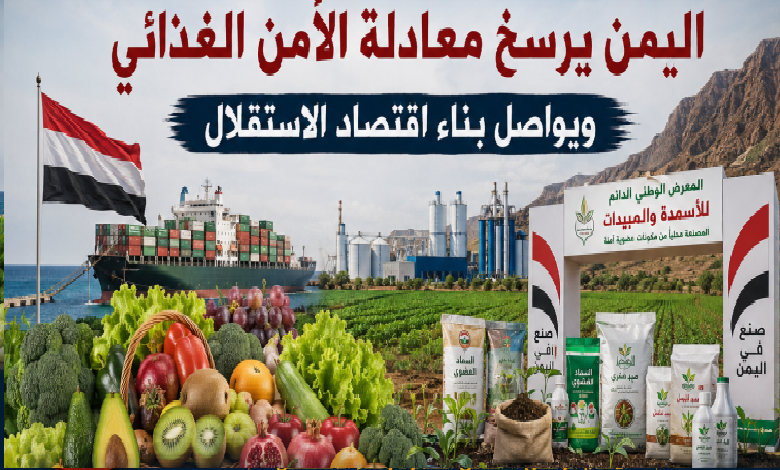
From self-sufficiency to exporting: Yemen consolidates its food security equation and continues building an independent economy.
The National Exhibition of Local Fertilizers and Pesticides reveals the features of agricultural and industrial transformation under the national state project.
In a scene reflecting the scale of the transformations taking place in the agricultural and productive sector in Yemen, Acting Prime Minister Allama Muhammad Ahmad Muftah inaugurated the National Permanent Exhibition for locally manufactured fertilizers and pesticides made from safe organic components, in a step that goes beyond its direct agricultural dimension to embody an integrated national path aimed at enhancing self-sufficiency, localizing industries related to food security, and establishing the foundations of an independent national economy based on production, not consumption, and on relying on self-capacities, not dependence on foreign entities.
This achievement comes in the context of the major transformations that Yemen has witnessed since the September 21 revolution, which restored the concept of national sovereignty in its various political, economic and cultural dimensions, and freed the Yemeni decision from external hegemony, to open the way for building an independent national vision that puts development, production and self-sufficiency at the forefront of priorities.
The September 21 Revolution: From liberating political decision-making to restoring economic decision-making power
Talk of self-sufficiency and the localization of agricultural industries was not possible in light of decades of economic dependence and subservience to foreign policies that turned Yemen into an open consumer market for imported products and weakened national productive sectors, especially agriculture and industry.
But with the victory of the September 21 revolution and the restoration of independent national decision-making, the state began to adopt a different approach based on rebuilding the national economy from within, investing local resources and capabilities, and turning the challenges imposed by the aggression and blockade into opportunities to advance national production.
The past years have proven that the blockade, despite the burdens and challenges it has created, has contributed to accelerating the move towards self-reliance, and has pushed official institutions, the private sector and society to search for national alternatives capable of meeting the needs of the local market and enhancing economic resilience.
Self-sufficiency is no longer a slogan, but a reality.
Among the most prominent statements made by Sheikh Mohammed Muftah during the opening of the exhibition was his confirmation that Yemen has reached a level of self-sufficiency in many basic agricultural products, most notably fruits and vegetables, with the surplus being exported abroad.
This development is a very important indicator of the extent of progress made by the agricultural sector in recent years, especially in light of the war and siege conditions that were directly aimed at weakening national production capacities.
The matter did not stop at achieving self-sufficiency in fruits and vegetables, but extended to the livestock sector, where the brand confirmed the key to achieving self-sufficiency in meat and eggs, while continuing efforts to achieve complete self-sufficiency in the dairy sector and its derivatives.
These indicators reveal a strategic shift in the structure of the national economy, in which Yemen is gradually moving from a stage of importing and dependence on foreign countries to a stage of production, exporting, and strengthening national food security.
Localizing new products: Yemen expands its agricultural production map
In a move reflecting the state’s ambition to expand the agricultural production base, Al-Allamah Miftah revealed the start of the localization of a number of new agricultural products that were not previously considered among the crops widespread in Yemen, most notably kiwi, avocado, and other varieties whose production has practically begun.
This trend represents a qualitative shift in the course of agricultural development, as it opens new horizons for farmers and investors, contributes to diversifying local production and increasing the economic value of the agricultural sector, as well as providing products that were largely dependent on imports.
The success of modern agricultural experiments also reflects the ability of the Yemeni people to adapt to challenges and invest in available natural resources to develop their production and improve its quality in a way that meets the needs of the local market and enhances opportunities for competition in foreign markets.
Local fertilizers and pesticides: A new pillar of food security
The National Permanent Exhibition for Locally Manufactured Fertilizers and Pesticides is of exceptional importan