
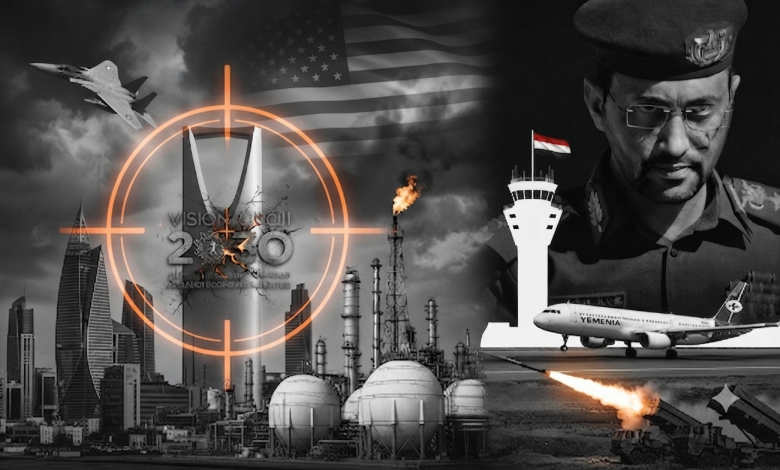
Aramco and Vision 2030 are at stake: Can Riyadh bear the cost of challenging Yemen’s decision to break the blockade to appease Washington?
The balance of military and political deterrence has shifted entirely in favor of Sana’a, putting an end to the arrogant and domineering Saudi regime’s eleven-year-long campaign of comprehensive aggression and systematic, unjust blockade. The moment the coalition’s warplanes dared to attempt to intercept a Yemeni civilian aircraft carrying over two hundred wounded and stranded citizens, the swift and decisive sovereign response came in the form of air defense missiles, establishing a new equation of engagement that transcended mere airspace protection to assert complete sovereignty by force of arms. This resounding Saudi blunder has once again proven to both local and international public opinion that Riyadh is nothing more than a subservient tool manipulated by the American administration and the Zionist entity, especially given Yemen’s honorable stance in support of the Gaza Strip. This renders the Saudi regime’s recent actions politically and economically suicidal, exposing its entire internal security to inevitable destruction.
Field and political realities reveal that Yemen’s insistence on breaking the blockade is no longer merely a negotiating demand, but a comprehensive strategic decision made by the revolutionary and political leadership and the armed forces, backed by overwhelming and irrevocable tribal and popular support. Saudi Arabia’s attempts to distort the facts through its military spokesperson, portraying civilian humanitarian flights as a threat to its security, reflect the extent of the confusion and futile arrogance of a regime that refuses to acknowledge the shifting balance of power. Based on the firm statements issued by the Yemeni Ministry of Foreign Affairs and the armed forces, the resumption of civilian air traffic to Sana’a International Airport and other ports is an inherent sovereign right of the oppressed and besieged people. Any attempt to stall or renege on the peace commitments and the roadmap brokered under the auspices of the Sultanate of Oman will be met with decisive military responses targeting the heart of the Saudi economy and its hypothetical Vision 2030 projects.
Sanaa missiles mark the beginning of breaking the siege
The Yemeni Armed Forces decisively put an end to Saudi Arabia’s policy of threats and intimidation, which attempted to impose its control over Yemeni airspace at 5:20 AM, when a hostile aircraft formation tried to intercept a safe civilian aircraft. The military announcement of the activation of air defense systems and the subsequent humiliating retreat of the Saudi warplanes marked the beginning of a phase of “direct operations to break the siege,” underscoring the fact that Yemeni airspace, airports, and ports are no longer open territory for the Saudi regime or its American and Zionist partners. This successful countermeasure represents a practical implementation of the revolutionary leadership’s directives to end the humanitarian suffering unconditionally and exposes the falsehood of the aggression’s narrative regarding its supposed openness to peace.
Sanaa no longer relies on lukewarm international stances or empty diplomatic promises. Instead, it now depends entirely on a strategy of imposing a fait accompli through force of arms and establishing a military balance. The courageous initiative of the Islamic Republic of Iran in facilitating this flight to transport patients, stranded individuals, and official and popular delegations constituted a powerful political blow to the Saudi-American embargo imposed for years. The military leadership has affirmed the readiness of all formations to continue and expand flights between Sanaa and Tehran, placing their trust in God and relying on a high level of combat readiness, ready to end the tutelage and cut off the hand of any aggressor who attempts to tamper with the human rights of the Yemeni people.
The recent military action was not isolated from popular support; rather, it coincided with tribal mobilization and a general call to arms issued by Yemeni tribes through extensive and armed gatherings. These gatherings endorsed the air defense operation and called for strikes deep inside Saudi Arabia. This crucial unity between the army and the tribes grants the political leadership absolute authority to go to the furthest extent in disciplining the Saudi regime and confronting its arrogance and reckless adventures. Any repetition of Saudi folly against civilian aircraft will only lead to the ignition of wider fronts and the closure of all airspace and ports to Saudi air traffic in retaliation, in accordance with the principle of comprehensive and reciprocal retaliation that will spare no facility or airport within the aggression coalition’s system.
A quarter of a million raids and silent extermination
The bl