
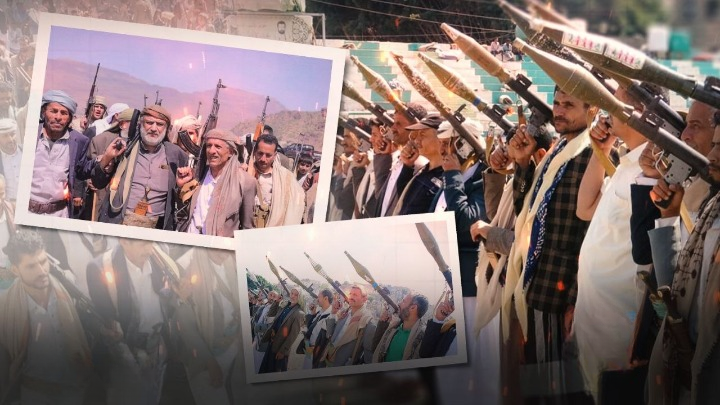
Following the path of the September 21 revolution, popular readiness supports the “siege for siege” equation.
The declaration of readiness in Yemen is no longer just a reaction to developments on the ground, but has become a deeply rooted national approach established by the September 21 Revolution, which rebuilt the relationship between the people and the state, and established an equation based on the fact that protecting sovereignty and reclaiming rights is a collective responsibility in which everyone participates, from universities and institutions to tribes and training and mobilization fields.
With the Yemeni Armed Forces’ decision to impose a naval blockade on the Saudi enemy coming into effect, according to the “blockade for blockade” equation, the Yemeni arena witnessed a broad popular movement that reflected the extent of popular support for this option, and confirmed that Yemen, with all its components, stands behind the battle to end the aggression, break the blockade, and restore national rights.
Sana’a University: Science in the Service of Sovereignty
In this context, more than 7,500 students from Sana’a University created a remarkable national tableau during a student parade in which 75 companies of mobilization forces participated. The participants carried the Yemeni flag and chanted slogans of freedom and disavowal of the enemies of the nation, affirming their readiness to participate in the next stage of escalation if the need arises.
The event was not merely a symbolic event, but a message confirming that the Yemeni university, which the aggression and siege have tried to weaken throughout the past years, is still playing its role in building a conscious human being capable of carrying the pen in defense of science, and the rifle in defense of the homeland.
The participants affirmed that the decision to ban maritime navigation for the Saudi enemy represents a legitimate right of the Yemeni people after many years of siege, renewing their readiness to participate in various fields of defending the homeland until the siege is lifted and legitimate rights are obtained.
General mobilization: Preparations expanding to all governorates
In Saada province, vanguard units of the mobilization forces carried out a combat maneuver that demonstrated an advanced level of readiness in carrying out combat missions and military tactics, in a message confirming that if the enemy imposes the option of confrontation, the Yemeni people will be ready for it.
The participants affirmed that Yemen possesses the will and full readiness to wage any battle imposed by the current stage until the aggression and blockade are ended, renewing their mandate to the leader of the revolution, Mr. Abdul-Malik Badr al-Din al-Houthi, to take the appropriate options to restore the rights of the Yemeni people.
Institutions are partners in the liberation struggle
The mobilization programs extended to state institutions, where the staff of the General Secretariat of the House of Representatives implemented a field application within the “Al-Aqsa Flood” program, as part of enhancing preparedness and raising the efficiency of national cadres.
The program included practical training on the use of weapons, along with cultural and awareness lectures, reflecting the broadening of the concept of mobilization to include building awareness, discipline and national readiness in various state institutions.
The tribes confirm their readiness
In the Al-Haymah Al-Dakhiliyah district of Sana’a Governorate, the people of Bilad Al-Qabail organized a march and a public rally during which they declared their full support for the decision to ban maritime navigation on the Saudi enemy, stressing their readiness to participate in the battle to seize national rights.
The participants also renewed their mandate to the leader of the revolution to take all strategic options, stressing that the Yemeni people will not back down from the battle to break the siege, no matter how great the challenges.
An approach established by the September 21 revolution
These activities, which extend from universities to state institutions, tribes and training fields, reveal a cohesive national situation that has been formed through years of resilience, which was established by the September 21 revolution that restored the concept of popular participation in defending the homeland, and linked construction, development and the ability to face challenges.
As the repercussions of the aggression and the blockade continued, the need arose to strengthen preparedness and comprehensive mobilization, and to consolidate community awareness and constant readiness to deal with the challenges of the stage, protect sovereignty, and restore rights.
Message of the stage
The scenes of continuous readiness confirm that