
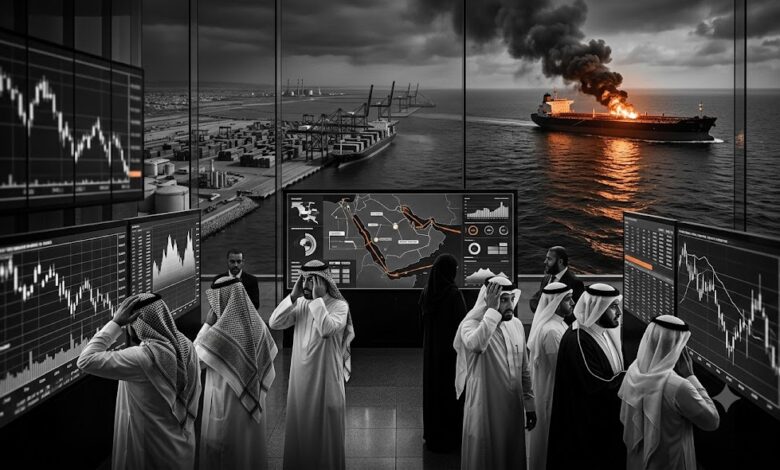
Deterrence begins at sea… How did Sana’a redraw the equation of pressure on the Saudi economy?
Maritime routes and logistics lines are the lifeblood of modern economies, particularly for strategic projects that rely on attracting investment and freedom of navigation. With the recent escalation in the Red Sea, the maritime confrontation has taken on unprecedented geo-economic dimensions, manifested in the imposition of a maritime blockade and the direct targeting of Saudi shipping lanes and western ports.
This report addresses the comprehensive consequences of this transformation, starting with the logistical chokepoint of ports and the direct impacts on supply chains and insurance costs, passing through the negative repercussions on “Vision 2030” projects and the investment environment, and reaching the strategic dilemma and the options available to the Saudi decision-maker.
Choking off logistical arteries and undermining investment
The precise designation of the maritime blockade and its direct targeting of Saudi shipping and ports has cast a heavy shadow on the Kingdom’s western ports, most notably Jeddah Islamic Port and King Abdullah Port. This direct targeting of shipping lines linked to Riyadh has led to a decline in unloading and transit traffic exceeding 50% at the western coastal ports, dealing a direct blow to the investment environment upon which the aggressor authorities rely.
The transformation of the Red Sea from a safe passage designed to attract capital into a direct confrontation line is reshaping the Kingdom’s sovereign risk assessment and forcing foreign investors to carefully reconsider their options in the face of a fragile and volatile geo-economic reality. This structural instability imposes increased operating costs, weakening the competitiveness of import and export companies within the Saudi market.
This partial navigational paralysis also leads to widespread confusion in the delivery schedules of goods and raw materials, which disrupts the production plans of the Saudi industrial sector concentrated on the coastal strip, and makes the continuation of this situation a continuous drain on the Kingdom’s logistical reputation.
A sharp decline exceeding 50% in unloading and transit traffic at western ports.
Disruption of supply chains for raw materials, basic commodities and food.
The investment rating of the Saudi maritime and logistics environment has decreased, and it has been classified as a high-risk area.
Insurance bleeding and supply chain depletion
The economic repercussions of the comprehensive maritime blockade extend far beyond the disruption of direct shipping, reaching into the very core of Saudi Arabia’s trade costs and the necessities of daily life. The perceived threat to Saudi shipping has led to unprecedented increases in “war risk” premiums imposed by global insurance companies, multiplying tenfold and imposing exorbitant additional charges of thousands of dollars on every container bound for Saudi ports.
In addition, global shipping giants like Maersk and Hapag-Lloyd have been forced to divert vessels linked to the Saudi regime and reroute them around the Cape of Good Hope, adding 10 to 14 days to the journey time and resulting in a sharp increase in fuel consumption and operating costs of up to 40%. These direct burdens are not limited to government budgets; they also weigh heavily on the private sector, which finds itself unable to withstand this continuous rise.
This compounded increase in shipping and insurance fees does not stop at the ports, but rather seeps directly into the prices of the end consumer within the Saudi markets, where imported consumer goods and foodstuffs have begun to witness escalating waves of inflation that erode the purchasing power of the Saudi citizen and increase the cost of economic adaptation for the Kingdom under the path of fire and deterrence.
Dissipating the ambitions of major investment projects
While Riyadh is banking on its western coastline to ensure the success of its Vision 2030 projects, the maritime blockade poses a structural obstacle to realizing these ambitions. The development of massive tourism and logistics complexes along the Red Sea necessitates a secure and stable environment, which has been undermined by Yemen’s repressive policies in response to the ongoing, unjust blockade.
These investment projects—most notably NEOM and the Red Sea tourist destinations—have become hostage to the lack of maritime stability and the disruption of supply chains for building materials and technologies. Attracting global tourism or developing special economic zones is impossible in an environment where maritime traffic is under intense pressure and targeting Saudi shipping. This reality places the multi-billion dollar projects of the aggression in a precarious position and deprives them of the essential elements for growth and development.
Attracting foreign inv