
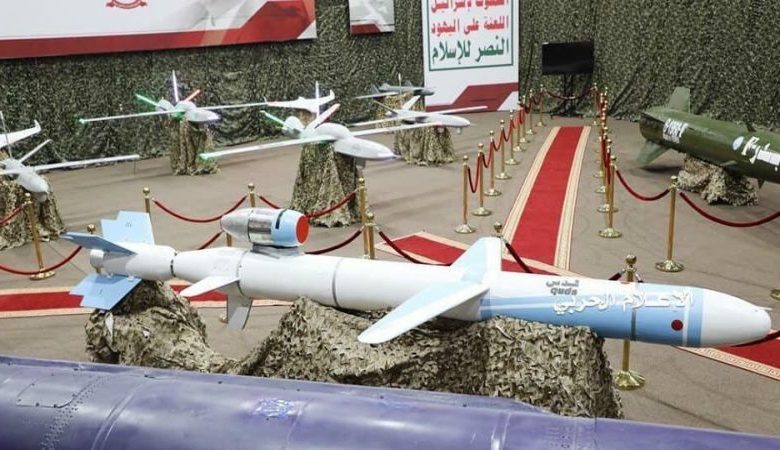
The Quds Missile System: A Strategic Achievement of the September 21 Revolution
The September 21 Revolution marked a pivotal turning point in building Yemen’s military power, as the armed forces moved from a phase of limited defense to possessing long-range strategic deterrence systems. Among the most prominent of these achievements is the Quds cruise missile system, which has brought about a qualitative shift in regional conflict equations due to its ability to strike vital targets with high precision.
Origins and Evolution of the Quds System
Sana’a first unveiled the Quds system in 2019 with the announcement that Quds-1 had entered service, featuring a range of 1,400–1,500 km. It was later used to target sensitive sites deep inside Saudi Arabia and the UAE. Continuous development followed, leading to advanced generations, including:
Quds-1 (2019): The initial operational deployment of long-range cruise missiles.
Quds-2 (2020): Range of 1,500–1,800 km, with improvements in accuracy and maneuverability.
Quds-3 (2022): Additional enhancements in range and operational capability.
Quds-4 (2023): Used for the first time to target the city of Eilat.
Quds-5: Later announced with a range exceeding 2,000 km.
Quds Z-0: A surface-to-sea missile designed to target ships and coastal objectives.
This progression confirms that the Quds system is a comprehensive strategic project undergoing continuous development within Yemen’s deterrence doctrine.
Operational Debut and Military Messages
On November 23, 2020, the Yemeni Armed Forces announced the targeting of an Aramco distribution station in Jeddah with a Quds-2 cruise missile, marking the first official declaration of its entry into service. The official spokesperson, Brig. Gen. Yahya Saree, stated that the strike was highly precise, prompting the deployment of ambulances and firefighting units.
The operation came as a response to the ongoing aggression and conveyed a clear message that Yemen’s target bank includes vital facilities deep within the aggressor states.
General Characteristics and Operational Impact
Available data indicate that Quds-2 features:
Low-altitude flight and maneuverability to evade advanced air defense systems.
High strike accuracy and a significant destructive effect compared to previous generations.
Military experts believe that the use of Quds-2 represented a qualitative leap in the operational performance of Yemen’s missile force, delivering a direct deterrent message to the aggressor states and normalization partners.
Regional Dimensions and Occupation Concerns
The repercussions of the Quds missiles were not limited to Saudi Arabia and the UAE; they also extended to the Israeli occupation entity, whose military institutions have expressed growing concern over Yemen’s capability to target ports and airports in southern occupied Palestine, including Eilat Port.
Attacks on Aramco facilities—particularly Abqaiq and Khurais—highlighted the vulnerability of air defense systems to precise and surprise Yemeni missile strikes.
Within Yemen’s Deterrence Equation
The Quds system is part of a broader strategy that includes long-range ballistic missiles such as Burkan and Dhu al-Fiqar, alongside Samad-3 drones, contributing to:
Expanding the target bank
Enforcing a deterrence equation
Shifting confrontation into the depth of aggressor states
Quds: Breaking Technological Superiority
The Quds missile system, led by Quds-2, underscores that the September 21 Revolution was not merely a political event, but a sovereign project that rebuilt Yemen’s military power despite blockade and aggression. It succeeded in establishing a new deterrence equation that made Yemen an influential actor in the regional conflict, affirming that willpower and sovereignty can break technological superiority and impose reciprocity in response.