
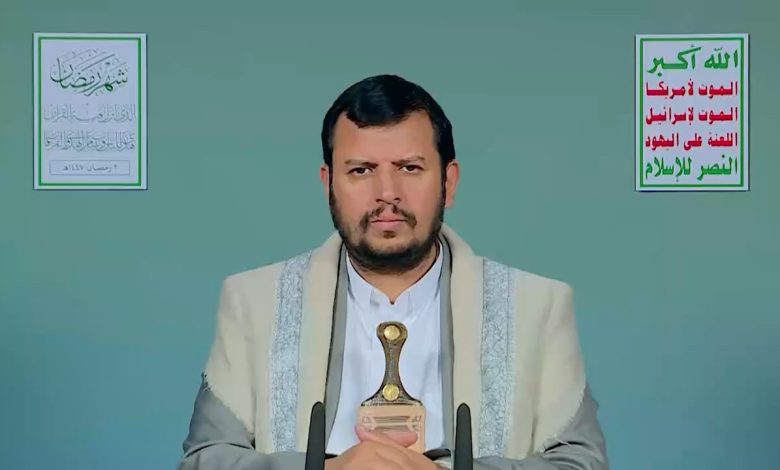
At the outset of his Ramadan lectures, the Leader lays out a roadmap for restoring the faith-based identity and confronting misinformation and soft warfare.
At the beginning of his Ramadan lectures for the year 1447 AH, the Leader, Abdul-Malik Badr al-Din al-Houthi, placed the month of Ramadan in its true context: not merely a fleeting season of worship, but a strategic juncture for rebuilding the individual, correcting the course of the nation, and restoring its faith-based identity in the face of a soft war targeting its consciousness, values, and connection to God.
The first lecture was not a traditional sermon, but rather an analytical Quranic reading of the nation’s reality, a precise diagnosis of its imbalances, and a direct link between civilizational decline and the flawed relationship with God’s commands and prohibitions, and the external targeting that seeks to diminish the manifestations of righteousness and faith within Muslim societies, especially among the youth.
Ramadan: A Great Divine Offer in a Time of Bewilderment
The Leader emphasized that God Almighty presents His servants with a magnificent offer of goodness during the month of Ramadan: multiplied rewards, elevated status, and open doors for repentance, purification, and spiritual growth. However, the tragedy lies in the weak understanding of this enticing and significant divine offer, at a time when the nation is most in need of this educational and spiritual gift.
According to the Quranic description cited by the Leader, the nation is experiencing a state akin to bewilderment: turmoil, terrible polarization, despair, confusion, weak awareness, and blindness to the true sources of danger. This state is not an imposed fate, but rather a direct result of a practical failure to adhere to God’s guidance and a widespread neglect of sacred duties and collective responsibilities.
Piety: The Greatest Gain and Strategic Protection
The Leader placed piety in its central position: it is the greatest gain from the month of Ramadan, and simultaneously, the most dangerous loss in the nation’s reality.
Piety is not merely an abstract emotional state, but a system of practical commitment to God’s commands and prohibitions, reflected in individual behavior, societal structure, and political decisions. Its absence has led to:
Widespread moral and behavioral imbalances.
Neglect of collective responsibilities.
Tons of internal injustice.
Humiliating subservience to the enemies of the nation.
A dangerous state of permissiveness in various spheres.
Therefore, restoring piety represents a comprehensive preventative project: prevention from divine punishment, prevention from internal collapse, prevention from historical replacement, and prevention from the greatest existential threat: God’s wrath.
The Holy Quran: From Recitation to Methodology. The Leader emphasized that the problem does not lie in the absence of copies of the Quran, but rather in the absence of a correct understanding of the Quran as a book of guidance, adherence, commitment, and action.
The noble verse, {Indeed, this Quran guides to that which is most upright}, is not a slogan, but a comprehensive corrective principle. Intellectual deviations, distorted concepts, following desires, and a lack of spiritual purity are all direct consequences of turning away from the Quran as a practical guide for life.
Therefore, Ramadan is not merely a season for intensifying recitation, but also for rebuilding one’s relationship with the Quran as:
The standard for evaluating reality.
The reference for correcting misconceptions.
The source for restoring awareness.
The foundation for formulating a stance on major issues.
The Soft War: A Systematic Targeting of Identity
One of the most prominent themes of the first Ramadan lecture by the Supreme Leader was the warning against the insidious soft war targeting the nation’s awareness and values, which seeks to:
Reduce the phenomenon of righteousness and faith.
Cease the segments of society engaged in religious duties and good deeds.
Target youth on a broad scale.
Dilute religious and moral identity.
This war does not rely on direct military confrontation, but rather on internal dismantling, distorting concepts, and creating a separation between humanity and the teachings of its Lord.
Confronting these challenges requires not emotional reactions, but rather an awareness of their gravity, strengthening one’s relationship with God, solidifying faith-based identity, and fortifying the younger generation with Quranic education.
Neglected Responsibilities Needing Revival: The Leader presented a frank accounting of what he described as negligence within the nation, including:
Jihad in the path of God.
Adherence to the rope of God.
Establishing justice.
Brotherhood in faith.
Enjoining good and forbidding evil.
Compassion, mutual support, and cooperation in righteousness and piety.
This collective negligence has been accompanied by practical imbalances in various political, economic, and security spheres, and by a state of dependency and surrender that has reached the point of accepting violation.
Therefore, Ramadan is an opportunity to reactivate these responsibilities within a practical program, not merely through emotional sentiment.
A Practical Program for Reconstruction
The Leader’s lecture did not merely diagnose the problem, but also presented clear practical paths, including:
Increasing supplication as an expression of true need for God and an investment in His nearness: {And when My servants ask you concerning Me, indeed I am near. I respond to the invocation of the supplicant when he calls upon Me.}
Deepening remembrance of God in heart and tongue, according to a methodology that establishes God’s constant presence in consciousness and behavior.
Charity, maintaining kinship ties, and performing good deeds as practical paths to attract God’s blessings in this life and the Hereafter.
Getting rid of the negative residues that have accumulated due to pressures, temptations, and psychological complexes, and making Ramadan an opportunity for comprehensive inner purification.
Preparing early for Laylat al-Qadr (the Night of Decree), as it is the peak of the season, and preparing for it from the beginning of the month by making preparations and taking the necessary steps for success.
Yemen: A Model of Preserving Religious Practices
In a general context dominated by targeting, the Leader pointed to the Yemeni people’s distinctive characteristic of frequenting mosques, engaging in worship, remembrance of God, and reciting the Quran during Ramadan, despite the challenges, considering this a blessing that necessitates gratitude and preservation.
This strong faith constitutes a strategic asset in the battle for identity, and affirms that faith-based identity is not merely a slogan, but a living practice deeply rooted in society.
Ramadan: A Comprehensive Correction Project
The Leader’s first Ramadan lecture outlined a clear equation:
A crisis-ridden reality caused by a flaw in the relationship with God.
External targeting that exploits and deepens this flaw.