
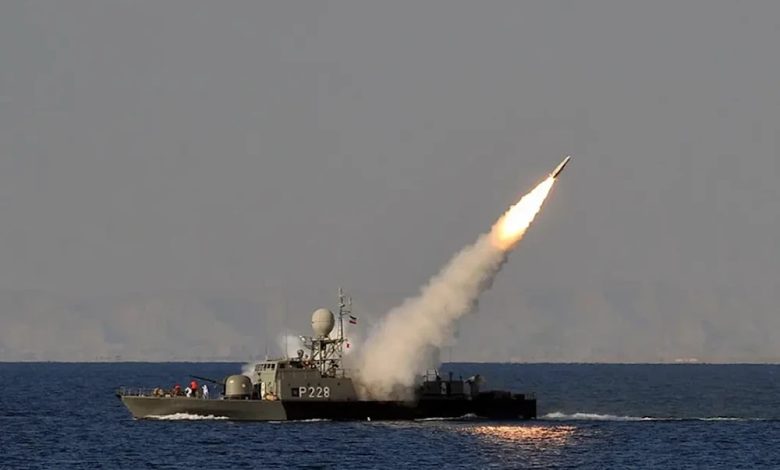
The Iranian navy forces US warships to withdraw from the Sea of Oman and warns of further escalation.
The Iranian army announced on Friday that it had carried out a qualitative naval operation in the Sea of Oman targeting two American destroyers and an assault landing ship that were conducting hostile and provocative activities, stressing that the operation resulted in the withdrawal of the American naval vessels from the region and their retreat towards the Indian Ocean.
The Iranian army explained in an official statement that the operation came in the context of continuing to confront the acts of maritime harassment and the seizure of commercial ships and oil tankers, which are practiced by the American enemy forces in the region, noting that the Iranian naval forces launched “Qadir” warning missiles and modern “Shahid Dana” attack drones towards the two American destroyers “DDG-103” and “DDG-87” after they carried out violations and provocations in the Sea of Oman.
The statement confirmed that the two American destroyers were forced to leave the Sea of Oman and head towards the Indian Ocean, while the American amphibious assault ship “Tripoli” was also forced to withdraw from the area, along with a number of naval vessels belonging to the American aircraft carrier group “George W. Bush”.
The Iranian military indicated that these naval vessels were carrying out activities that disrupted the security of navigation and maritime trade in the region, stressing that the recent Iranian operations sent a clear message regarding the high readiness of the Iranian naval forces and their ability to confront any hostile movements near Iranian territorial waters.
In the same context, the Command and Control Center for Iranian naval operations stressed the need to stop the hostile acts and maritime piracy by the US and Zionists, stressing that the Iranian armed forces will continue to monitor hostile movements and take appropriate measures to protect the security of the region and its vital maritime routes.
The center stressed that the US naval vessels moving away from the range of the missiles used in the current operation does not mean the end of response options, explaining that the Iranian navy possesses long-range missile capabilities that will be resorted to when needed if the threats or hostile attempts continue.
For his part, the Iranian television correspondent reported that satellite images showed the dispersal and spread of the US fleet’s units in the region following the Iranian operation, noting that the US fleet had tried about 48 hours earlier to advance towards the Gulf with its navigation systems disabled, but it faced a direct response from the Iranian naval forces that forced it to retreat.
He added that the Islamic Revolutionary Guard Corps Navy informed ships passing through the region that it is ready to secure the passage of civilian shipments and essential goods, including fuel and food, through the Strait of Hormuz, as part of measures to secure navigation and protect maritime trade.
These developments come amid an escalating Iranian naval presence in strategic waterways, especially after Tehran announced earlier the establishment of a maritime control zone in the Strait of Hormuz, a move that confirms the Islamic Republic’s commitment to its role in protecting the security of waterways and confronting any attempts to impose foreign military hegemony in the region.
According to observers, the latest operation reflects an advanced level of readiness and operational capability of the Iranian naval forces, and confirms the continuation of the maritime and political confrontation between Tehran and Washington in one of the most sensitive regions for global trade and international energy security.