
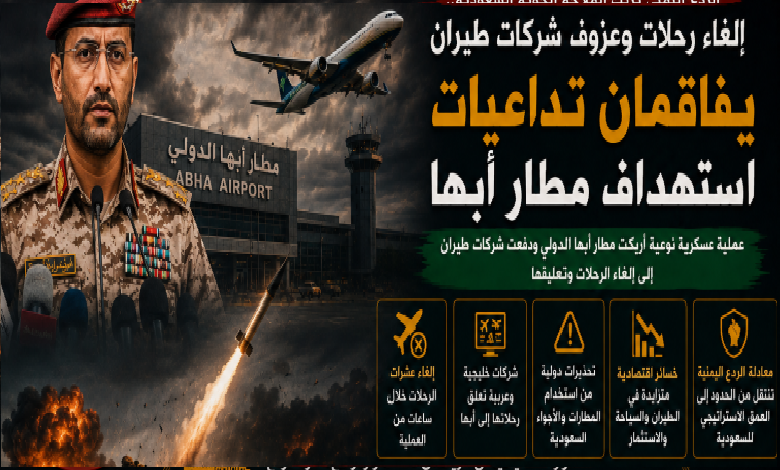
Yemeni retaliation disrupts Saudi air traffic; flight cancellations and airline reluctance exacerbate the repercussions of the Abha airport attack.
The field and economic repercussions of the Yemeni military operation that targeted Abha International Airport continue, in a development that reflects the widening impact of the deterrence equations imposed by the Yemeni armed forces on the course of the confrontation with the Saudi regime, and confirms that the continuation of the policies of escalation and siege is now carrying an increasing cost to the vital sectors within the Kingdom, most notably the air transport, tourism and investment sectors.
Hours after the Yemeni armed forces announced the execution of a military operation targeting Abha International Airport in response to the targeting of Sana’a International Airport, the effects of the operation began to appear rapidly on civil aviation traffic, with a wave of cancellations and delays of flights, and an increase in the level of warnings related to the use of the airport and the surrounding airspace.
A military operation brought Abha airport back to the forefront of the confrontation.
The Yemeni Armed Forces announced a military operation targeting Abha International Airport using missiles and drones, asserting that the operation was in retaliation for the brutal and blatant Saudi aggression against Sana’a International Airport. The military statement also included a warning to airlines against continuing to use Saudi airports and airspace while restrictions on Sana’a Airport remain in place.
According to consistent media reports, the operation caused a significant disruption to air traffic associated with Abha Airport, while flight tracking data showed the cancellation of a large number of scheduled flights in the hours following the operation.
Gulf and Arab airlines suspend flights
As an indication of the level of concern raised by the operation, several airlines announced the cancellation or suspension of their flights to or from Abha.
Newspaper reports indicated that the Emirati company “Flydubai” cancelled its flights linked to Abha Airport, and other companies joined the temporary suspension measures pending clarification of security developments and the level of risks associated with air navigation in the region.
Media reports also spoke of additional cancellations of flights by Gulf and Saudi companies, while flight tracking data indicated that dozens of flights were halted and cancelled during a short period of the military operation.
This trend reflects the level of sensitivity with which airlines deal with any potential threat to the safety of civil aviation, as air carriers rely on accurate security assessments before maintaining their operational routes in areas of tension.
Economic dimensions that go beyond direct losses
The repercussions of any disruption at international airports are not limited to the operational aspect alone, but extend to include broad economic sectors that are directly or indirectly linked to air transport.
Abha Airport is one of the most important gateways to the Asir region, a tourist destination that Riyadh has focused on in recent years as a key component of its tourism development projects. Any decline in air traffic or increased security concerns would negatively impact tourist bookings, business activity, investments, and airport-related services.
Airlines also typically incur additional costs as a result of cancelling, rescheduling, or diverting flights, as well as their obligations to affected passengers, which adds increasing financial and operational burdens as the uncertainty continues.
International warnings and their impact on travel
Recent developments have not been limited to airlines, but have extended to warnings issued by foreign entities and countries regarding travel to and use of some Saudi airports.
These warnings are of particular importance given their direct impact on the decisions of insurance companies, tourism companies and international travelers, as they often lead to raising the risk assessment associated with the destinations covered, which is subsequently reflected in travel and investment.
Observers believe that continued tensions related to airspace may present Saudi authorities with increasing challenges in maintaining the smooth flow of air traffic and convincing international airlines to continue operating their flights normally.
The Yemeni deterrence equation: From the borders to the strategic depth
During the years of aggression, the capabilities of the Yemeni armed forces developed remarkably, and operations moved from the scope of border confrontations to targeting vital facilities, airports and sites deep inside Saudi Arabia.
The past years have witnessed