
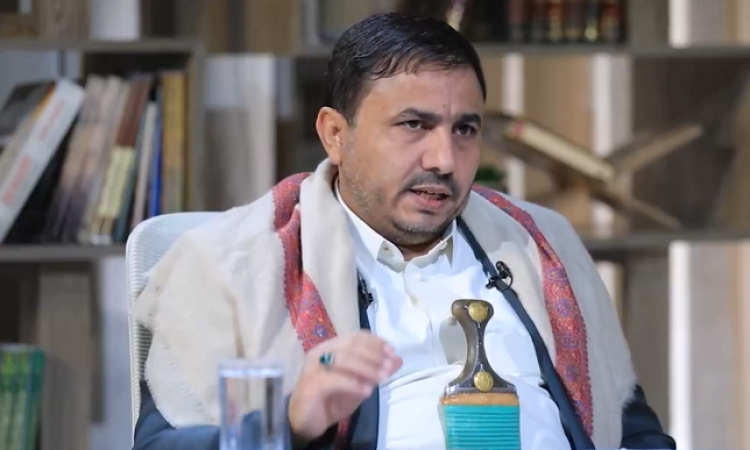
Al-Farah: Lifting the blockade is a legitimate Yemeni right, and attempts to link it to Iran are a cover to justify aggression and targeting national sovereignty.
Ansar Allah Political Bureau member Mohammed Al-Farah asserted that attempts to link legitimate Yemeni demands or national movements to Iran represent a blatant attempt to divert attention from the core of the Yemeni issue, which is the right of the Yemeni people to end the aggression, lift the siege, and restore their full sovereignty over their land, decision, and resources. He considered these claims to be nothing more than a political and media cover to justify the continuation of the aggression and the siege imposed on Yemen.
Al-Farah explained, in a series of posts published on his account on the “X” platform, that whoever raises questions about the timing of the Yemeni movements should direct them to the Saudi regime, which chose military escalation by targeting Sana’a International Airport and Hodeidah port, stressing that these attacks came as an extension of the siege and pressure policy that the Yemeni people have been subjected to for years, which made defending national and sovereign rights an option imposed by the facts and not subject to postponement.
He pointed out that Yemenis have endured for more than twelve years the consequences of the blockade and the closure of airports and ports, and the resulting widespread humanitarian, economic and living crises, explaining that these measures have deprived millions of citizens of their most basic rights, foremost among them the freedom of travel and movement, treatment and access to basic needs, and have exacerbated the suffering of various segments of society.
The member of Ansar Allah’s political bureau stressed that holding Iran responsible for what is happening in Yemen is an attempt to escape the real causes of the crisis, asking how any country’s foreign relations can become a pretext for imposing a siege on an entire people, violating its sovereignty, or violating its lands, ports, airports, and national wealth.
He stressed that establishing relations with various countries of the world is a sovereign right guaranteed by international norms and laws for every independent state, and does not give any external party the right to impose guardianship, military intervention, or control over national decisions, noting that Yemen, like other countries, has the full right to build its foreign relations in a way that achieves its national interests, away from any dictates.
Al-Farah criticized the double standards of some regional regimes, explaining that they maintain declared relations with the Zionist enemy entity and provide it with various forms of political and economic support, while they consider Yemen’s relations with other countries as a justification for continuing the aggression and the blockade, in a contradiction that reveals the political use of these pretexts to serve goals that go beyond the Yemeni issue.
He stressed that the Yemeni issue is not linked to any country or axis, but rather revolves around legitimate national rights that the Yemeni people seek to obtain, foremost among which are lifting the blockade, opening airports and ports, guaranteeing freedom of travel and movement, paying the salaries of state employees, stopping the plundering of national wealth, and ending all forms of foreign interference in Yemeni affairs.
He explained that these demands express the needs and basic rights of Yemenis and do not serve any external agenda, noting that the continued blockade and measures imposed on sea and air ports have caused great damage to the economic, service and humanitarian sectors, and have directly affected the lives of citizens and their living conditions.
Al-Farah accused the Saudi regime of using its policies to serve the American and Zionist project in the region, explaining that the tightening of the siege on Yemen coincided with the Yemeni military operations supporting the Palestinian people in the Gaza Strip, considering that the pressures that Yemen was subjected to came within the framework of attempts to dissuade it from its positions supporting the Palestinian cause and to prevent any position against the Zionist entity.
He stressed that Yemen is acting based on its legitimate right to defend its sovereignty and independence and to reject foreign tutelage, and that portraying these positions as subservience to Iran aims to distort national demands and divert attention from the real reasons for the crisis, foremost among them the continued aggression and blockade.
In concluding his remarks, the member of Ansar Allah’s political bureau stressed that history proves that Saudi interventions in Yemeni affairs preceded various political