
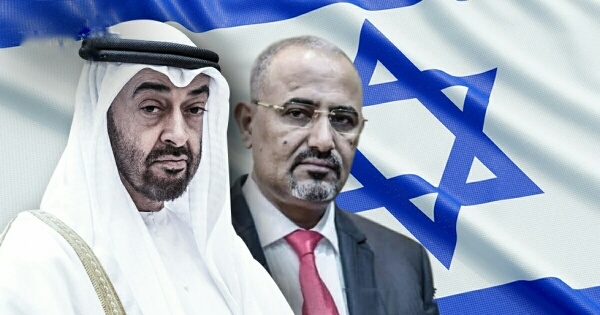
From Aden to Tel Aviv: How the “Southern Transitional Council” Became an Emirati Tool to Market Normalization in Exchange for the Illusion of Secession
At the heart of the occupied southern governorates, a reality long concealed by the American, Emirati, and Saudi aggression—and their local instruments—is now coming fully into view: the so-called Southern Transitional Council (STC) is no longer a fleeting local actor, but has become a functional tool within a regional project aimed at suffocating Yemen’s sovereignty, undermining its unity, and transforming the south into a political and military platform for normalization with the Zionist entity. This transformation, carefully engineered over years, could not have been completed without direct Emirati support, American international cover, and explicit Israeli endorsement—placing the region before a new reality in which local tools serve foreign interests at the expense of the homeland and its people.
This context is further reinforced by the alignment of public statements made by STC leaders with occupation policies, as well as their practical experiments in cooperation with the Zionist entity—from openly declaring readiness for normalization, to direct military alignment in the Red Sea and Bab al-Mandab, and even hosting Zionist media delegations in Aden. These facts demonstrate that the south has become a functional platform serving external agendas, and that every move made by the STC is part of a broader project aimed at besieging Sana’a, neutralizing its regional influence, and securing Israeli interests—an overt challenge to Yemeni sovereignty and the principles of national resistance.
The Meeting That Exposed the Role of Mercenarism
Within this broader framework, the issue is no longer one of potential normalization or indirect communication; the scene has shifted to concrete realities exposing the true role played by the STC on the ground.
In Aden, the depth of the Emirati-backed STC’s full slide toward normalization with the Zionist entity has become unmistakable. A meeting that brought together a delegation of mercenaries and Zionist officials was not an isolated incident, but a clear indicator of how southern Yemen is being transformed into a platform for political and military coordination in favor of the Zionist enemy. These movements reflect an advanced stage of functional integration, where talk of “local interests” has become little more than a slogan, while every action is directly tied to foreign agendas—at the expense of Yemen’s sovereignty and national unity.
These revelations were not confined to media leaks; they extended to direct on-the-ground presence by figures linked to Zionist security and military institutions.
Prominent among them is journalist and military analyst Jonathan Spyer, who recently visited Aden—not as a neutral observer, but as a witness to the Emirati mercenaries’ descent into the swamp of normalization. Known for his coverage of conflict zones in Syria, Iraq, and Lebanon, Spyer met with mercenary leaders during his visit and reviewed military arrangements coordinated with elements of the Zionist enemy. His meetings reportedly included discussions of advanced military requirements, such as air-defense systems, reconnaissance drones, and nighttime operational plans—revealing the depth of undeclared coordination and its direct impact on Sana’a’s resilience and regional capabilities.
This step was not limited to the field level; it aligned seamlessly with the public political discourse of Aidarous al-Zubaidi, who openly confirmed his readiness to normalize relations with “Israel” in exchange for international support for the secession project, and his willingness to participate in protecting Zionist vessels in the Red Sea and Bab al-Mandab.
This field engagement fully complements al-Zubaidi’s public political rhetoric, which leaves little ambiguity: political statements, field meetings, Zionist visits to Aden, and declared military readiness all form links in a single chain confirming that mercenaries have become a functional instrument serving the Zionist enemy’s project.
If meetings and visits reveal one side of undeclared coordination, al-Zubaidi’s explicit political discourse provides it with unmistakable legitimacy.
Added to this are Spyer’s visit and documentation, which showed that Aden’s meetings were part of broader coordination encompassing security, military, and media dimensions—placing the south squarely at the heart of the normalization project and making any mercenary movement part of a long-term enemy plan aimed at marginalizing Sana’a and controlling the strategic waterways of the Red Sea and Bab al-Mandab.
Ultimately, these facts confirm that no political or military activity undertaken by the STC can be considered independent or local; rather, it represents the execution of a regional function that prioritizes Zionist interest