
Gaza Between Siege and Flooding: An Imminent Health System Collapse
In the Gaza Strip, the humanitarian catastrophe is no longer confined to bombardment and destruction. It has expanded into its most dangerous silent front: public health and the environment. With the siege continuing, the repercussions of the assault, and a harsh winter, successive health crises are erupting among hundreds of thousands of displaced people amid a collapsed infrastructure, widespread water contamination, and acute shortages of medicines and medical supplies—raising the alarm of a potential outbreak that could spiral out of control at any moment.
An Acute Health Threat
Bassem Zaqout, Director of Medical Relief in Gaza, warned of the risk of leptospirosis spreading among displaced communities after five confirmed cases were recorded—four of them in intensive care.
The disease is believed to have been transmitted through stagnant, contaminated floodwater caused by rainfall mixing with sewage, alongside the spread of rats—making children, women, and the elderly the most vulnerable.
Zaqout explained that although the disease does not spread from person to person, it may still expand widely due to the unsanitary environment. He also warned that diagnosis is difficult because its symptoms resemble those of viral hepatitis, especially given the lack of specialized laboratory testing equipment.
Winter Flooding
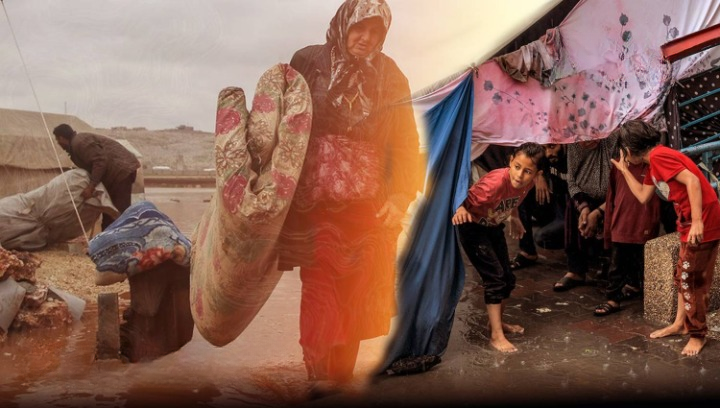
Alongside the health danger, recent weather systems have exposed the fragility of shelter conditions. Gaza’s Civil Defense reported the total collapse of 18 residential buildings and dangerous partial collapses affecting more than 110 additional buildings.
Civil Defense spokesperson Mahmoud Basal noted that more than 90% of displaced persons’ tents were either flooded or blown away. Emergency crews reportedly received over 700 distress calls. These conditions have led to the deaths of 25 people, including six children who died from extreme cold.
He emphasized that tents have completely failed as a humanitarian solution and no longer provide any protection from rain or wind—deepening the daily suffering of displaced families.
Water Contamination and the Spread of Hepatitis A
Bashar Murad, Director of Health Programs at the Palestinian Red Crescent Society in Gaza, announced the spread of Hepatitis A, describing it as a direct indicator of contaminated drinking water.
He stated that roughly 80% of water networks have been destroyed, forcing residents to rely on transported water. Laboratory tests reportedly found that such water contained viruses and bacteria that cause gastrointestinal infections, which have spread widely—especially among children—due to overcrowding, cold, and environmental pollution.
“A Slow Death Sentence” for Cancer Patients
In an even darker picture, Dr. Mohammed Abu Nida, Medical Director of the Gaza Cancer Center, said cancer patients in the Strip are facing a “slow death sentence” because of severe shortages of oncology medications, the absence of diagnostic services, and the closure of crossings preventing patients from traveling abroad for treatment.
Abu Nida described these factors as a “triangle of death,” stressing that saving patients requires urgent action to enable them to travel and receive care without delay.
An Escalating Disaster
UNRWA reported that heavy rains have caused extensive flooding in displacement sites. While its teams are working to open sewage networks and pump out water, the scale of the catastrophe exceeds available capacities—especially under the continued siege and restrictions preventing the entry of necessary materials and equipment.
Gaza at Risk
What Gaza is experiencing today goes beyond an emergency humanitarian crisis—it is becoming a compounded disaster where war, siege, environmental collapse, and health-system failure intersect. With ongoing attacks and international inaction, disease, flooding, and cold are turning into silent instruments of death, claiming civilian lives—especially children and the sick. Immediate, comprehensive intervention remains the only option to avert a large-scale health and humanitarian breakdown that may later be impossible to contain.