
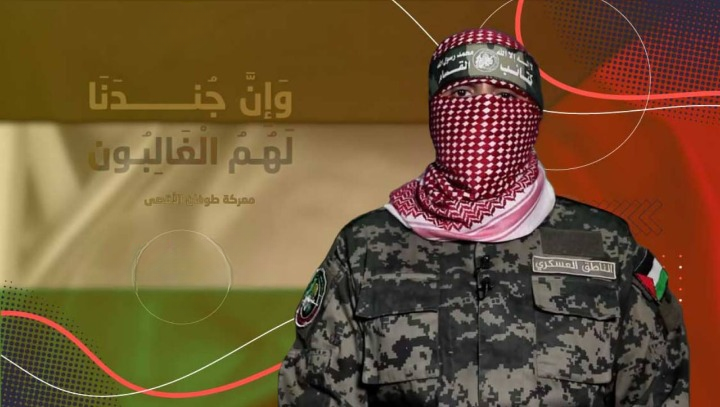
Abu Obeida: The Voice of the Resistance That Shook the Enemy—Until Martyrdom
The martyr Hudhaifa Samir Al-Kahlout, known as “Abu Obeida,” was not merely the military spokesperson of the Izz ad-Din al-Qassam Brigades. Over more than two decades, he became a de facto leader of the resistance’s media front and a central voice in the battles of awareness and psychological warfare with the enemy entity. With his martyrdom, the curtain falls on an exceptional journey—of a commander who waged confrontation with words as much as with weapons—leaving a deep imprint on the conscience of resistance supporters and a persistent disruption in the enemy’s calculations.
Since his first public appearance in 2004 during the “Days of Rage” battle, Abu Obeida established a disciplined model of resistance media: sparing in appearances, issuing statements only when the battlefield dictated the moment. He thus became one of the most prominent symbols of the ongoing confrontation with the enemy, until his martyrdom on the path to Jerusalem.
Concealed Identity, Enduring Impact
Behind the mask and keffiyeh, Abu Obeida’s identity remained shrouded in secrecy despite repeated attempts by the enemy to uncover or target him. For years, the enemy possessed nothing more than media speculation—promoted without resolution—while Qassam sources affirmed that his identity would remain a secret, undisclosed.
This ambiguity, combined with consistent performance, lent added power to his discourse and made each appearance an exceptional event—eagerly anticipated by resistance audiences and closely monitored by Hebrew-language media. Israeli analysts themselves acknowledged that his statements often carried greater credibility than the official narrative of the enemy’s army.
The Discourse of Battle: When the Word Becomes a Weapon
During major confrontations—most notably “Sword of Jerusalem” (2021) and “Al-Aqsa Flood”—Abu Obeida played a pivotal role in managing collective awareness, both within Palestine and across the Arab and Islamic worlds. His words coincided with battlefield developments, announcing realities in confident language, free of exaggeration yet decisive in meaning.
Among the phrases etched into public memory was his description of rocket strikes deep inside the enemy entity as “easier for us than drinking water,” and his consistent closing of speeches with the words of martyr Izz ad-Din al-Qassam: “It is indeed jihad—victory or martyrdom.”
Al-Aqsa Flood: The Media Zenith
With the outbreak of the Al-Aqsa Flood battle, Abu Obeida’s voice became the defining address of the confrontation. Successive audio and video messages addressed the prisoner file, enemy losses, and attrition strategy, turning his statements into daily material for political and media debate—inside and outside Palestine, and even within Hebrew-language media itself.
During this phase, his name became the most circulated, and he emerged as a leading symbol of psychological warfare that unsettled the enemy and broke its monopoly over the narrative.
Martyrdom of the Commander, Continuity of the Message
On December 29, 2025, the Islamic Resistance Movement (Hamas) announced the martyrdom of Abu Obeida in the Al-Aqsa Flood battle, closing the chapter of a man who led Qassam’s military media for more than twenty years.
Yet this chapter did not truly end. A new Qassam spokesperson declared that the title “Abu Obeida” would remain present and that the message would continue—underscoring that the resistance is not confined to individuals, but to an idea, a creed, and a path.
An Enduring Legacy
With Abu Obeida’s passing, the resistance loses one of its most prominent media figures, but it retains a legacy that established a new equation: disciplined speech is a weapon; field-based credibility is power; and resistance media is a front no less important than the battlefield.
Abu Obeida taught that when a voice emerges from the heart of the battle, it is more eloquent than any propaganda arsenal—and that the mask is not concealment of a face, but the elevation of a symbol.