
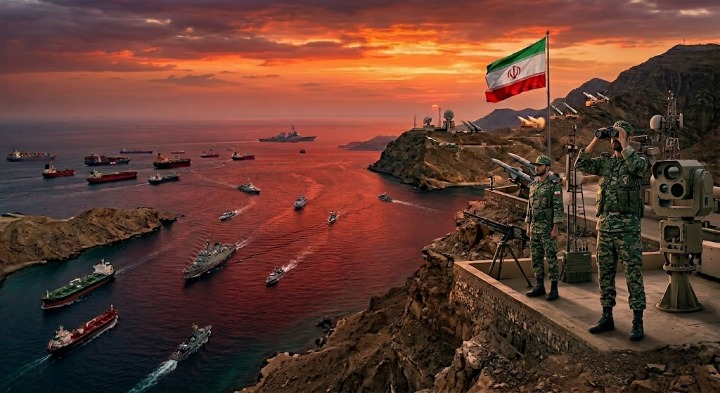
Hormuz: A Crucial Sovereignty Card… How is Iran Redrawing the Power Equations through the Strait?
In a highly complex regional moment, the statement issued by Iran’s Supreme National Security Council affirmed that the Strait of Hormuz is no longer merely a vital waterway, but has transformed into a sovereign and strategic tool managed within a comprehensive equation encompassing the military arena, the global economy, and political engagement with the United States and its allies.
Hormuz: The Global Energy Artery at the Heart of the Confrontation
The Strait of Hormuz is one of the world’s most important maritime chokepoints, through which a significant portion of oil and gas exports pass, making it a key pivot in the international energy security system. From this perspective, any control over navigation within it is not to be interpreted as a limited tactical measure, but rather as a shift in the global balance of power.
The Iranian statement explicitly placed this reality in its proper context, asserting that the majority of supplies for US military bases in the Gulf pass through the Strait, which Tehran considers a direct threat to its national security, necessitating the imposition of monitoring and control commensurate with the level of risk.
From the Battlefield to the Strait: The Intertwining of Power and Negotiation
What is striking in the Iranian discourse is the organic link between battlefield achievements and the negotiating position. Tehran asserts that the failure of the aggression and its military resilience are what compelled Washington to shift from a logic of force to requesting a ceasefire and sitting down at the negotiating table.
This intertwining reflects a clear approach:
The battlefield dictates policy, and the Strait translates it economically and strategically.
Iran does not treat the Strait of Hormuz as a separate issue, but rather as a direct extension of the confrontation’s outcomes. Its opening or partial closure becomes a tool of pressure in negotiations, not merely a security measure.
Conditional Opening: Redefining Freedom of Navigation
The noteworthy aspect of the statement is not the threat to close the Strait, but rather the introduction of the concept of “conditional and limited opening,” a qualitative shift in the management of international waterways.
Instead of accepting what is called “freedom of navigation” in its traditional form, Tehran proposes an alternative model based on:
Restricting passage to commercial vessels.
Prohibiting military vessels or those belonging to hostile states.
Subjecting passage to direct supervision and authorization by the Iranian Armed Forces.
Precisely defining transit routes.
Imposing obligations related to safety, the environment, and costs.
This model reflects a shift from open freedom of navigation to sovereignly managed navigation according to the littoral state’s terms, which carries legal and political dimensions that extend beyond the region.
Hormuz as a Multi-Dimensional Deterrent
The statement places the strait at the heart of a complex deterrence equation that transcends the traditional military dimension to broader dimensions:
Economic deterrence: Direct impact on global energy markets.
Logistical deterrence: Disrupting supply lines to US military bases.
Political deterrence: Using the strait as a bargaining chip in negotiations.
Regional deterrence: Linking its opening to a ceasefire on various fronts, including Lebanon.
Here it becomes clear that Tehran is not using Hormuz merely as a defensive tool, but as a means to reshape the rules of engagement in the region.
Negotiations Under the Constraints of the Battlefield
The statement reveals that the negotiation process was not separate from the developments of the confrontation, but rather a direct result of them. The United States’ acceptance of an Iranian negotiating framework and its engagement in lengthy rounds of regional mediation reflect a shift in the balance of power.
However, Tehran insists it will not accept the enemy’s excessive demands, leading to the suspension of negotiations pending adjustments to the terms to align with the realities on the ground.
This high negotiating ceiling is reinforced by the use of practical leverage, primarily control of maritime routes.
The Domestic Front as a Strategic Lever
In addition to the external dimensions, the statement places particular importance on the domestic front, calling for continued popular participation and national cohesion.
This reflects an understanding that the ability to manage international waterways begins with internal stability and a strong national front.
The Iranian equation, as presented in the statement, rests on three integrated pillars: a solid domestic front, a cohesive domestic front, and strategic leverage.
Where is this equation headed?
In light of these factors, the Strait of Hormuz appears poised to become one of the most significant determinants of the next phase, not only as an energy corridor but also as a tool for redistributing influence in the region.
The core message of the statement can be summarized in a clear equation:
Maritime security and national sovereignty are inseparable.
There can be no negotiations without a balance of power.
And there can be no stability in international waterways without considering the interests of regional powers.
Thus, the Strait of Hormuz transforms from a mere strategic waterway into a focal point of an open-ended conflict, the contours of which are being shaped by the interplay of military, political, and economic factors, at a time when new balances of power are emerging across the entire region.