
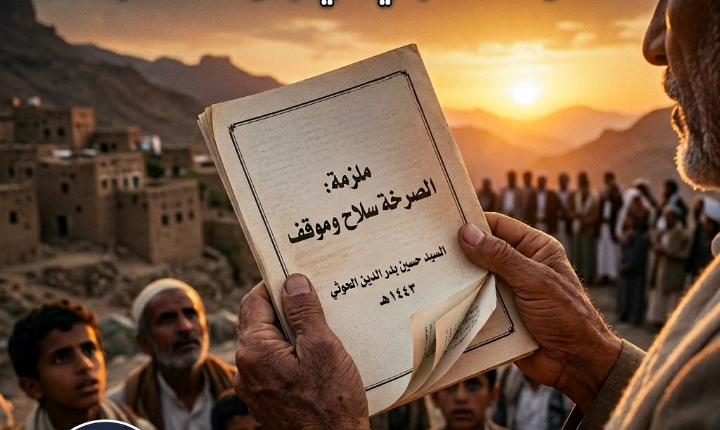
The Cry: A Weapon and a Stance… The Resurgence of the Quranic Stance in a Time of Defeat
The treatise “The Cry: A Weapon and a Stance,” delivered by the martyr leader Sayyid Hussein Badr al-Din al-Houthi on the 11th of Ramadan, 1423 AH (corresponding to November 15, 2002 CE), is a foundational document of paramount importance in the trajectory of the Quranic project. Its significance extends beyond its role as a declaration of a political stance; it constitutes a comprehensive strategic vision, a profound philosophy of confrontation, and an accurate reading of the reality of the Islamic nation under American and Israeli hegemony.
This analytical reading derives its importance from delving into the profound themes presented by the martyr leader, attempting to unpack the strategic, philosophical, and pragmatic dimensions that transformed the “Cry” into more than just a slogan—a potent weapon and a decisive stance in the battle for consciousness and existence.
The Strategic Dimension: Breaking the Silence and Redirecting the Compass of Enmity
The martyred leader begins his analysis with a precise diagnosis of the state of “silence” and “inaction” that has gripped the Muslim world, especially in light of the escalating American and Israeli aggression under the guise of “combating terrorism.” The martyred leader believes that this silence is not merely a passive state, but rather a fertile ground that allows enemies to implement their plans without resistance.
In this context, the “slogan” emerges as a strategic tool to break this silence. It is a clear and explicit declaration identifying the true enemy of the Muslim world (America and Israel) and redirecting the compass of enmity toward this enemy, instead of being preoccupied with peripheral conflicts or succumbing to despair.
The martyred leader emphasizes that raising the slogan is not a futile act, but rather a “legitimate and effective action.” As soon as people raise the slogan, they send a powerful message to the enemies that there is a growing awareness of their danger and that the Muslim world is no longer submissive to their schemes. This very awareness constitutes an obstacle to hegemony, as the enemies realize they are facing a vigilant nation, prepared for confrontation.
The Philosophical Dimension: The Quranic Stance and Faith-Based Responsibility
The vision of the martyred leader in this treatise is founded on a solid Quranic basis. He does not present the “slogan” as a tactical political option, but rather as an unavoidable “Quranic stance” and “faith-based responsibility.” The martyred leader cites numerous Quranic verses that warn against allying with Jews and Christians, command confronting them, and emphasize the importance of taking a firm stance against them.
From this perspective, the martyred leader believes that failing to raise the slogan or take a stand against the enemies is not merely a political shortcoming, but rather a “shirk of faith-based responsibility” and a “clear violation of Quranic directives.” He stresses that faith is not merely a claim, but a practical commitment manifested in stances and actions, foremost among them being disavowal of the enemies of God.
This profound connection between the political stance and the religious responsibility imbues the “scream” with immense driving force, transforming it from a mere political slogan into a religious duty through which one draws closer to God, thus ensuring its continuity and strength in the face of challenges.
The Practical Dimension: Exposing the “Soft War” and the Importance of the Economic Boycott
The martyred leader does not confine himself to philosophical and strategic theorizing; rather, he delves into the details of lived reality, warning of the dangers of the “soft war” waged by the enemies to target the nation’s consciousness and identity. He also points out that the enemies do not rely solely on military force, but also utilize media, culture, and economics to infiltrate and subdue Muslim societies.
In confronting this soft war, the martyred leader proposes the “economic boycott” as an effective and influential weapon. He emphasizes that the boycott is not merely a symbolic act, but a painful blow to the enemy’s economy, which represents the backbone of their power. He calls for a boycott of American and Israeli goods as an integral part of the comprehensive stance against hegemony.
The martyred leader also warns against attempts by enemies and their agents to distort the slogan or diminish its importance, pointing out that these attempts are conclusive proof of the slogan’s impact and the threat it poses to their projects.
The Cry as a Tool for Internal Fortification and Nation-Building
One of the most important dimensions highlighted in the treatise is the role of the “Cry” in the internal fortification of the nation. The martyred leader believes that raising the slogan contributes to building a collective, resistant consciousness and protects society from cultural and intellectual infiltration. It is a tool for cultivating pride and dignity, and rejecting humiliation and subservience.
Furthermore, the martyred leader considers the Cry a first step towards building a strong and independent nation, capable of defending itself and its sacred values. It is a call for practical action, overcoming stagnation, and actively contributing to the civilizational revival of the Islamic nation.
In conclusion,
The booklet “The Cry: A Weapon and a Stance” represents a historically and strategically vital document. It offers a profound analysis of the nation’s reality and presents a comprehensive vision for confrontation. Time and events have proven the martyr leader’s vision to be correct, as “The Cry” has transformed from mere words uttered in Maran into a widespread liberation project that is altering the dynamics of conflict in the region and affirming that a sincere word and a principled stance are the most powerful weapons against arrogance.